
Inside Chicken Run
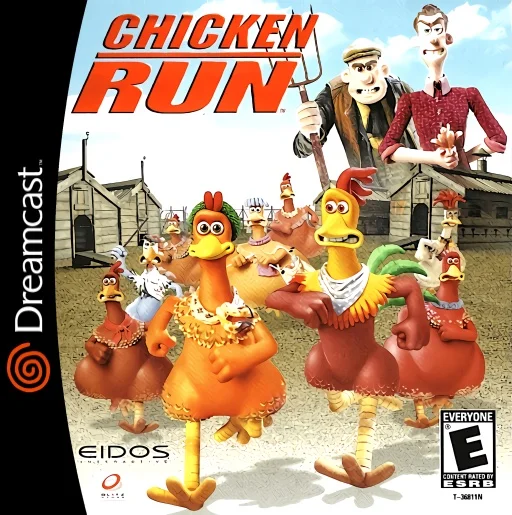
Developed by Blitz Games (formerly known as Interactive Studios Limited) in 2000 as a cross-platform action adventure based on the movie of the same name. Eidos published it for Dreamcast, PlayStation, and Windows 1. The isl prefix on libraries such as islfile.c and islfont.c is that earlier company name.
The stranger details survive in the game’s source code. This was not a package prepared for an audience. It circulated in a wider bundle of Dreamcast projects, although its original provenance remains unclear.
What survived captures far more than the finished port. The folders preserve a Katana build, the PlayStation PSYQ version, a Visual Studio 6 project, and fragments inherited from Frogger 2, Action Man 2, Glover, and Titan.
It is a working history of the game rather than a polished release. There are duplicate source trees, empty headers, programmer jokes, demo stubs, disc-building instructions, and a small model viewer that still introduces itself as the Frogger 2 shell. The GD Workshop project for the disc CHICKENRUN1 was created on 25 July 2000 and modified on 10 August 2000.
Explore the source
The complete copy contains 820 files across 7 folders. Its shape explains the rest of the article: one Dreamcast working tree, a PlayStation source directory, a nearby snapshot, copied library headers, and a small model viewer.
Of the 217 filenames shared by cr and cr/Copy of source, 122 match byte for byte and 95 differ. chase.h is empty in both. These are development folders frozen at different moments, not a clean source release.
The game folder holds the Dreamcast working copy, the PlayStation tree, a snapshot, and a PSI model shell.
The browser below turns the directory into a reference index. Opening a folder explains its role before listing its contents; selecting a file shows its purpose, inferred from comments, declarations, and surrounding code. The shortcuts lead directly to the main platform trees and the model shell.
The index omits file contents and filesystem dates. Those dates record when this copy was written to disk, not when Blitz authored each file.
Loading archive index...
Reading the source
Before following the code into the build environment, these are the internal names used throughout the project:
- BFF - A
.BFFfile that packs a room into one container of typed segments. Each segment has a type code, a length, and a name CRC. The letters are never expanded. - DCK - Dreamcast Katana. Prefix on the Katana-specific maths, texture, and system files.
- FlatPacker - The compressor in
islfile.c. Packed data starts with the little-endian magicFLA2. - FMA - The frog-map format. The F stands for Frogger.
map_draw.hcalls the blocks frog-map segments. The remaining letters are never expanded. - ISL - Interactive Studios Limited, the studio name in the library copyrights. It prefixes files such as
islfile.candislfont.c. - PSI - The studio’s PlayStation model format.
psi.ccalls itself the PlayStation model handler. - PSYQ - The PlayStation SDK named by
makefile.mak:ccpsx,dmpsx,asmpsx, and PSYLINK. - SPT - A texture stream.
sptstream.hloads one straight into VRAM. - VMU - The Dreamcast memory card. The tree has save code, icon bytes, and a 48 by 32 LCD image for it.
Development environment
With the folders mapped, their chronology becomes easier to read. The evidence points to a PlayStation-origin codebase that was adapted for Dreamcast, while a PC build supported development and the Windows release. global.h still identifies the project as CRTest PS, shared rendering code speaks in PlayStation GTE terms, and a Dreamcast audio file explicitly calls itself a "Dreamcast conversion".
That does not mean Blitz finished the PlayStation game and then made a clean, one-way port. The branches continued to evolve together. Platform wrappers, newer regional files, and duplicate snapshots record overlapping development rather than a simple before-and-after sequence.
PlayStation-only details
The PlayStation version sits in cr/source. Its makefile is headed CRTEST PS MAKEFILE and calls the PSYQ compiler, assembler, and linker from c:\psx\bin.
The later PlayStation header contains the final US, European, and UK product codes. Its memory-card filename combines the appropriate BA or BE prefix, the regional product code, and the suffix CHRUN.
Memory pressure shapes this build. The PSYLINK scripts begin at 0x80010000, then place the video player, three groups of mini-games, and the debug menu into overlapping banks. Only one bank occupies that region at a time. Fred’s linker note also gives the model plotter the data-cache area and warns that only leaf routines should run there.
The PlayStation performance display counts work in VSync units. Its frame target changes between 520 units for NTSC and 620 for PAL, and an over-budget frame turns the graph red.
Three regional masters
The final PlayStation pipeline knows exactly which executable it is making:
| Build | Video mode | Product code | Languages |
|---|---|---|---|
| US | NTSC | SLUS-01304 |
US English |
| Europe | PAL | SLES-03285 |
Multiple languages |
| UK | PAL | SLES-03188 |
UK English |
Select a region below to see the TERRIT block that produces that master.
NTSC. Prefix BA. LOTS_OF_LANGUAGES is 0. Memory-card name BASLUS-01304CHRUN.
PAL. Prefix BE. LOTS_OF_LANGUAGES is 1. Memory-card name BESLES-03285CHRUN.
PAL. Prefix BE. LOTS_OF_LANGUAGES is 0. Memory-card name BESLES-03188CHRUN.
master.bat turns those choices into a repeatable production line. It regenerates C dependencies, invokes the correct makefile, converts the PSYQ CPE executable with cpe2x, sets the stack pointer to 0x801fff00, and renames the result to match the regional product code. datstak then packs the loose CD files into CRTEST.DAT.
The demo follows the same path with crdemo.cpe, CRDEMO.EXE, and CRDEMO.DAT. The PlayStation tree includes most of the machinery that produced a master candidate.
Dreamcast-only details
The Dreamcast conversion occupies the root of cr. Its makefile includes $(KATANA_ROOT)\Sample\dc.inc, selects Kamui 2, and links Sega and CRI libraries for video, audio, and system services.
The platform-specific files use a DCK_ prefix, short for Dreamcast Katana. Katana was Sega’s code name for the console. DCK_System and DCK_Texture are typical examples.
main.h defines DREAMCAST_VERSION and maps familiar engine calls onto Kamui scene and pass operations. main.c requests two framebuffers and sets 0x150000 * 2 bytes aside for texture memory. Andy Eder dated the DCK maths and system layer 19 January 2000, providing a firm date for Dreamcast-specific porting work.
The conversion favours compatibility layers over wholesale replacement. Dreamcast-specific files sit around the shared engine and translate its assumptions into Katana graphics, audio, and storage services. Those bridges become the focus later in the article.
The Dreamcast profiler uses syTmrGetCount() instead of VSync units. It converts timer counts to microseconds and draws green workload strips against a three-frame grid.
This copy is not self-contained. include.h expects shinobi.h, kamui2.h, sg_syhw.h, sg_sycbl.h, and machine.h, but none of those Sega SDK headers are present. Building it requires the Dreamcast Katana development kit.
Building the GD-ROM
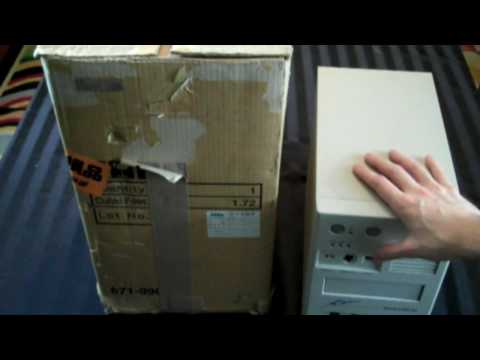
The Dreamcast disc project turns the source tree into a map of Tweedy’s farm. chicken.scr is a GD Workshop script for CHICKENRUN1, with its system area generated by Katana’s IPMaker.
The companion project, chickenrun.cpj, names the locations as files and directories. A few line up directly with the gameplay modules:
| Act | Rooms named in the GD project |
|---|---|
| 1 | Dog chase, egg hut, coop, garden, Fowler |
| 2 | Catapult, fireworks, seesaw, engine hut, wings hut |
| 4 | Flying machine, construction, egg game, pie barn |
Act 3 appears through video files rather than the room names in this table. The project includes ACT3INTRO.SFD, ACT3OUTRO.SFD, a boss clip, and a bonus clip.
chicken.scr names 654 files on CHICKENRUN1. Choose a view below to compare types, acts, and BFF counts measured from those File entries.
A ten-step note in in.txt records the daily ritual for replacing a room on the development disc: run makelevdc, unload the executable in CodeScape, remove the previous files in GD Workshop, and copy the replacement from W:\ChickenRun\cd_\Game\cd\. It is the kind of mundane instruction that makes the archive feel like a desk someone has just left.
PC conversion and shared code
The PC path is another adaptation of the same PlayStation-shaped core. A commented-out check in global.h captures the tension:
#ifdef _WIN32
	#error This is a PSX program, you dolt!
#endif
Fred Williams’s inline assembler required a more practical solution. James Steele added PSX_PC.h so custom.c, custom2.c, and map_draw.c could compile on PC without creating a second drawing engine:
/* Since Fred insits on being such a clever bugger and using in-line assembler, this
   file contains a load of macros so that the custom.c, custom2.c and map_draw.c
   compile and work on the PC as well as the PSX without me having to write a whole
   load of PC draw routines. */
The Visual Studio 6 project is an external target rather than a replacement for the console makefiles. Its SourceSafe path, $/teamManta/CRunDC/source, preserves a small piece of the studio’s original source-control layout.
Secret doors for testers
The most direct route through Tweedy’s farm did not appear on the map. global.h enables EIDOS_DEBUG_STUFF with the comment "Even in burns". In this source snapshot, holding R3 turns the D-pad into a QA selector:
| Input | Action |
|---|---|
| R3 and Up or Down | Select Mannequin, a mini-game, All Videos, All Levels, or 6 Eggs |
| R3 and L1 | End the current room and run the selected shortcut |
Hold R3 and step through the live testnames labels below. The function names keep the source spelling, including levflowCheatToManniquin.
R3 and L1 ends the current room and calls levflowCheatToManniquin.
The list walks Catapult, Fireworks, Seesaw, CogChase, Construct, Engine, Wings, then Crate.
Unlocks the video shortcut through levflowCheatAllVids.
Unlocks the level shortcut through levflowCheatAllLevs.
Gives the egg shortcut through levflowCheatEggs.
This proves that publisher-facing shortcuts were enabled in the working build. It does not prove that every retail disc retained the same define.
There is a second entrance with no menu label. SwimCheatCycle() watches both analogue sticks for a four-stage sequence of directions. Completing it on the language screen prints "Going to the Development stuff" and opens the internal viewer. The same recogniser is called by the dog chase and most mini-games, where it acts as a quick completion shortcut.
Step through the four analogue poses below. Neutral sticks reset language_cheatmode.
Left stick near 1024 and right stick near 3076 advances the first stage. Either stick in the dead zone calls SwimCheatReset().
ang1 1024 / ang2 3076
Both analogue sticks must sit near 2048 at once. Completing the pose increments language_cheatmode.
ang1 2048 / ang2 2048
The sticks swap their first-stage angles, 3076 on the left and 1024 on the right.
ang1 3076 / ang2 1024
Both angles must sit near 0 or 4096. The next poll returns 1, prints Going to the Development stuff, and opens the internal viewer.
ang1 0 / ang2 0
The internal viewer can start individual levels, mini-games, inventory screens, credits, and videos. Context flags tell the game whether it was entered normally, as a replay, or from debug, so the test harness can share the retail code without duplicating its level flow.
The farm behind the film
The development environment explains how Chicken Run was built. The runtime shows what the team was tuning. The film’s cast divides neatly along a C module boundary: charactr.c handles “characters that aren’t enemies”, while Chris Wilson’s enemies.c grew separate modules for the dogs and Mrs Tweedy.
The level-specific files are more revealing than their names suggest. dogchase.c controls the act 1 pursuit and its Mrs Tweedy mannequin. crate.c contains the later sequence in which she hangs from the aeroplane. sprouts.c implements the throwable sprouts used to distract guard dogs.
Even the dogs expose a design decision. Their route boxes include the collision radius plus a margin of 310 units. The comment explains why: without that extra distance, a dog outside the player’s reach will never stop to bark.
What the hourglass measures
The hourglass is the farm’s shared language for danger. Lighting, noise, dogs, and Mrs Tweedy all send events to hourglass2Inform(). That function chooses how much sand to add or switches the display into a full alert state.
The major signals come from otherwise separate systems:
| Source | Hourglass event | Meaning |
|---|---|---|
| lights.c | HOURGLASS_IN_LIGHT |
Ginger is standing in an alert-enabled light |
| lights.c | HOURGLASS_IN_SEARCHLIGHT |
A cone-shaped searchlight has found her |
| enemies.c | HOURGLASS_MAKING_LOUD_NOISE |
A movement or action was noisy enough to carry |
| nme_dogs.c | HOURGLASS_DOG_IN_GROWL_MODE |
A dog has progressed from suspicion to confrontation |
| nme_mrst.c | HOURGLASS_IN_MRT_FOV |
Mrs Tweedy has Ginger in her field of view |
Choose a source below to follow its path into hourglass2Inform(). The amounts are source constants, not seconds.
HOURGLASS_IN_LIGHTHOURGLASS_LIGHT_TIMEhourglass2InformHOURGLASS_IN_SEARCHLIGHTHOURGLASS_SEARCH_TIMEhourglass2InformHOURGLASS_MAKING_LOUD_NOISEHOURGLASS_LOUD_TIMEhourglass2_repeat_this_amountHOURGLASS_MAKING_QUIET_NOISEHOURGLASS_QUIET_TIMEhourglass2InformHOURGLASS_IN_MRT_FOVHOURGLASS_MRT_FOV_TIMEhourglass2InformHOURGLASS_DOG_IN_GROWL_MODEhourglass2_in_alert_stateHOURGLASS_ALERT_TIMEThis makes the hourglass more than a countdown graphic. It is a readable summary of several AI systems that do not otherwise know about one another. Light can fill it for a fixed duration, quiet movement can add a smaller warning, and pursuit can latch the game into an alert state.
Hiding under the welly
The welly does not make Ginger invisible. Every enemy carries a welly_suspicious_timer, and the disguise succeeds only while that enemy remains unconvinced.
The rules form a small suspicion model:
| Action | Result |
|---|---|
| Move while visible inside the welly | Add 128 suspicion units per check |
Duck into STATE_HIDING |
Remove 32 units while the enemy remains uncertain |
| Leave the enemy’s view | Remove 200 units per check |
| Cross 4096 units | The enemy knows Ginger is inside |
| Put the welly on while already observed | Reveal the trick immediately |
Drag through the source timer below. The bar is remaining disguise, not a HUD graphic.
The timer is still at rest. One movement tick in view adds 128 and starts the bar draining.
The programmer’s comment describes the intended rhythm better than a design document:
// You can just about sneak around under the welly if you do it in short bursts with long waits,
// Coz *if he's undecided about the welly*, he calms down to zero
Alert-enabled lights also check for the active disguise. When the welly or gnome is visible, EXLIGHT_SetupActorLightsAlert() disables the alarm test before calculating the actor’s lighting. The disguise therefore has to fool both the enemy vision code and the light-trigger system.
How the dogs listen
Dog hearing is based on Ginger’s animation, not her measured velocity. An older speed-based test survives as commented code in DogCanHearCheck(). The live version reads the current animation segment:
| Animation | Hearing range |
|---|---|
GINGER_WALK |
1200 world units |
GINGER_RUN |
2000 world units |
| Anything else | No hearing response from this check |
Choose a detection route below. Hearing follows the current animation segment. Sight and the lounge dog are separate checks.
animation.animData[0].segmentPATROL_DOG_HEARS_WALK_RANGEDogCanHearCheckanimation.animData[0].segmentPATROL_DOG_HEARS_RUN_RANGEDogCanHearCheckdefault in DogCanHearCheckreturn 0DogCanHearCheckPATROL_DOG_SIGHT_RANGEPATROL_DOG_SIGHT_FOVPATROL_DOG_KILLER_RANGEpos.vy - 1000selected_item == GNOMEWATCHING_DOG_SIGHT_FOVThe distinction is deliberate, although the comment calls it “running rather than tiptoeing/walking”. It also means the animation state is part of the stealth simulation. If movement and animation ever disagree, the dog’s ears follow the animation.
The final attack distance records a piece of publisher feedback. An earlier value of 800 is commented out beside the active range of 650, with the note "okay 800's too big (according to Eidos testers" layered directly into enemies.h.
One dog ignores the general rules. In the act 4 lounge, it cannot see a rat carrying the gnome and will not detect a rat high on the windowsill. The comments record the measured geometry: rats can jump 650 units above the dog, while the sill is 1152 units higher. If the dog does see the player at floor height, its growl state triggers an immediate guard-dog fail.
Eyes for every dog
The enemies can share one PSI model, but they cannot share one pair of animated eyes. When the engine finds a second enemy using the same model, it creates a texture instance and redirects that model’s eye pointers to an independent animation target.
Normal dogs blink at random. Sleepy and angry states use blinkOverride to hold a particular eye frame:
if (pE->blinkOverride != -1) {
    textureSetAnimation(pE->readData.animeyes.pAnim, pE->blinkOverride);
}
The result is economical and expressive: one geometry model can appear several times in a room, while each dog blinks independently or keeps its eyes shut, alert, or angry.
Mini-games with a medal
Chicken Run breaks the escape into small mechanical jobs. subgame.h awards fail, bronze, silver, or gold, while each activity supplies its own start, update, drawing, and camera code:
| Subgame | What the source says it is |
|---|---|
| Catapult | The level 2 catapult game |
| Construction | A saw, a hammer, and a spanner, with a camera on Mrs Tweedy |
| Egg laying | Feed, eat, swallow, lay, relief |
| Engine | An oiler, a biker, a pumper, and a power gauge |
| Fireworks | The fireworks game |
| Seesaw | The seesaw game |
| Stilts | Specialist control research. The comment says it should have been an overlay |
| Wings | Pole, material, and stitch workers |
Egg laying keeps three small state machines in egglaying.h. Choose one below to see the chicken, grain, or session sequence.
EGGLAYER_FEEDME through EGGLAYER_RELIEF. Idle and breath sit beside that working loop.
EL_GRAIN_STOPPED through EL_GRAIN_STARTING control whether grain is moving at a station.
The session enum also has separate succeed, fail, and medal states after EL_RUNNING.
station.c provides the rotating camera for the level 4 hub where several of these activities meet. On PlayStation, the mini-games become overlay banks in the linker script. The magazine demo goes further: demostub.c replaces features absent from the OPSM build with empty functions, allowing the rest of the game to compile without being covered in conditional blocks.
The Dreamcast has another snapshot of the game’s public life. ectsmenu.c implements the menu used for its ECTS demonstration.
The medal display has its own visual joke. subgame.c calls the structure CricketScore and draws progress as an animated cricket-style tally. Five line textures build each mark over several frames, changing colour as the score crosses the bronze, silver, and gold thresholds.
Map pieces that follow the player
Map pieces are deliberately duplicated across acts. Barry Paterson’s comment explains the reason: a piece missed in one act should still be available in the next.
At the beginning of each level, inventoryRemoveDuplicateMapPieces() compares the scenery against the 14 saved collection flags. Any copy the player already owns is removed from the scenic list. The level designers could place another chance to collect a piece without creating duplicates in the player’s inventory.
Try collecting the fourteen flags below. The board is schematic; the save stores map_pieces_got[14], not a bitmask.
0x00Each slot is one of the 14 map_pieces_got flags. The hex value is only this board's overlay, not a field in the save.
How a level is built
A BFF is a file. Each published room is one .BFF, a container of typed segments such as A1_DOGCHASE.BFF. The letters are never expanded in the source.
The stealth systems, puzzles, and mini-games all depend on data produced outside the runtime. The published act data is stored differently on each platform:
- Dreamcast - each room has its own BFF and SPT. Many rooms also have matching
.SBBand.SBHsound banks. The GD Workshop script lists them by room name, such asA1_DOGCHASE.BFF. - Windows - the same act folders, with
.WABfiles kept beside the.BFFand.SPTdata. - PlayStation - the loose files are packed into
CRTEST.DAT. That archive also includes aDUMMYfile filled with00padding.
The surviving headers expose the boundary between Chicken Run and a set of level compilers that are mostly absent from the archive.
A frog map under the farm
FMA is the map format. The F stands for Frogger. map_draw.h still calls the world data frog-map segments, one of the clearest traces of Frogger 2 in the project.
The runtime structures must match a separate PC map compiler. With SHORT_MAP_VERTNOS enabled, Chicken Run expects mesh formats 5 and 6. map_play.c draws the playable view, map_view.c supplies the fly-through, and lev_flow.c decides where the player goes next. Puzzles and scenic objects sit in their own systems instead of becoming full enemies.
Some of the comments read like notes passed across a busy office. In platcoll.c, Fred reserves an idea for the moment when the main collision code becomes available:
// I'll do these things for platforms, with a view to copying 'em into the main collision code
// when it's free. Luv, Fred.
The platform system has an even longer memory. platform.h says it was adapted from Glover.
Inside a BFF
A BFF is a file on disc, not a folder. BFF_LoadFile opens one .BFF and treats it as a packed list of objects. The source never expands the three letters.
bff_load.c calls that list a collection of data segments shoved together into one file. Each segment begins with a BFF_Header: a type code, the segment’s total length, and the CRC of its name.
typedef struct BFF_HeaderTag
{
    unsigned long id;
    unsigned long len;
    unsigned long crc;
} BFF_Header;
Chicken Run does not load a level as a loose directory of objects. After the file is in memory, a link routine for each type rebuilds pointers. BFF_FindObject then searches by type and CRC. A zero CRC means “the only object of this type”, a useful shortcut for data that appears once per level.
The type is a four-character code stored little-endian, with a version in the final byte. These are the versions defined by this source:
| Code | Header | Use |
|---|---|---|
| COL1 | collide.h | Collision |
| PSI0, PSI1 | custom.h | PSI models |
| FMA1 | fma.h | Frog-map info |
| FMM5, FMM6 | map_draw.h | Frog-map meshes when short vertex numbers are on |
| FMW0, FMW2 | map_draw.h | Frog-map worlds |
| NME1 | bff_load.h | Enemies |
| PUZ0 | puzzles.h | Puzzles |
| LEV5 | puzzles.h | Level info |
| CAM0 | puzzles.h | Camera info |
| PLT1 | platform.h | Platforms |
| SNC0 | scenics.h |
Scenic objects |
| ROU0 | route.h | Route boxes. ROU1 is the bevelled variant, and it is not the active define |
| TAN0 | overlays.h | Texture animation |
| SBH0 | sound.h | Sound-bank header. The old VH type is commented out |
| STG0 | platform.h | Sound triggers |
Choose a load path below. The loader marks the last segment, then calls a link routine for each type.
BFF_LoadFile / fileLoadwork->len |= 0x80000000BFF_Link_PSI1 / BFF_Link_FMA_Meshwork->idBFF_FindObjectBFF_FindNamedObjectBFF_PSI1_IDBFF_Link_PSI1BFF_PSI_IDBFF_Link_FMA_MeshBFF_Link_FMA_WorldBFF_FMA_MESH_IDplatform.h warns that the external level tool cr_lev includes the same structures. That compiler is not present, so the BFF definitions are both documentation and one half of a missing toolchain.
FlatPacker
The BFF data can be wrapped again. islfile.c recognises FlatPacker files by 0x32414C46, the little-endian bytes FLA2, then expands them with an LZ77-style decoder. Its history window is 4096 bytes and its longest back-reference copies 17.
On PlayStation, the loose disc files are collected into an index. Both test.c and sptstream.c default to CRTEST.DAT with the CD version suffix ;1. The generic example MYGAME.DAT survives beside it in a comment.
Streaming the plan screen
The planning screen had to fit through a narrower gap. sptstream.h sends an SPT texture directly to VRAM instead of holding the complete file in main memory.
Its comment describes a concrete swap: unload FRONTEND\INVENTORY1.SPT, then stream in FRONTEND\PLAN.SPT. The implementation was not yet linked into the game. The file helpers it needed were still private to another module.
Porting the assets and save system
Once a level is loaded, the same PlayStation ancestry appears in the assets around it. The Dreamcast code wraps, translates, and reuses older systems. Interface textures, sound names, and even the shape of the save payload show the previous platform underneath.
The same menu art on a new GPU
The Dreamcast menus still load Sony TIM images. menu.c asks for SHELL\BACKDROP.TIM; the credits load FRONTEND\SPLASH\ACT1.TIM; and the ECTS menu draws TIM versions of the Chicken Run, Blitz, and Eidos logos.
DC_TIM.c is the bridge. It reads 4-bit, 8-bit, 15-bit, and 24-bit TIM data, expands indexed colours, and builds a texture suitable for Kamui. In the indexed-colour paths, PlayStation magenta becomes transparent Dreamcast RGBA1555:
if ((r == 0x1f) && (g == 0) && (b == 0x1f)) {
    *bitmap++ = RGBA1555(r, g, b, 0);
} else {
    *bitmap++ = RGBA1555(r, g, b, 1);
}
Instead of sending every menu screen back through an art pipeline, the port teaches the new console how to understand the old console’s pictures.
Two kinds of progress in one save
The save system separates what the player has permanently unlocked from where the current run has reached. GameSaveDataType holds medals, best times, available levels, movies, and gallery stills. GamePlayDataType holds inventories, tasks, collected eggs and sprouts, moving-platform states, and the 14 map-piece flags.
The split supports replay. A comment in card.h describes two gameplay states: the saved position and a temporary replay position that is never written back to the card. Replaying an earlier act can therefore use its own inventory and room state without damaging the main game.
The structure packed onto the card contains three distinct layers:
| Layer | Contents |
|---|---|
| Options | Permanent control and presentation settings |
| State | Unlocks, medals, best results, and total play time |
| Play | Current inventories, tasks, pickups, and world state |
A Sony header inside a Sega save
The payload retains a PlayStation memory-card header. cardBuildBlock() writes the Sony magic bytes SC, copies the same icon into all three header slots, and converts the title "Chicken Run" to Shift-JIS.
On Dreamcast, islcard.c takes that payload and builds a Sega backup-file image around it. The outer file has VMU comments, palette data, an icon, and the raw game save. Before and after the write, the code sends status graphics to the VMU LCD.
It is port archaeology in a single file: Sega’s backup API on the outside, with the layout of a PlayStation save still visible within.
Choose a route below to follow the Sony header, the three save layers, or the VMU wrapper.
header.magicSHELL/SAVEICON.SPTasciiStringToSJISOPTIONDATASTR optionsGameSaveDataType stateGamePlayDataType playcardDisplay(LCD_saving)buMakeBackupFileImagecardDisplay(LCD_ok)Sound names beside the samples
Dreamcast sound effects live in Audio64 .kat banks. The loader sends those samples into audio RAM, but the bank does not supply the old name-based lookup expected by the game.
Blitz restores that layer from a companion text file. For every sample, islsfx2.c reads a WAV filename from AUDIO\<bank>.txt, removes the extension, converts the name to uppercase, and calculates the CRC used by the game:
utilUpperStr(fname);
bank->sample[loop].nameCRC = utilStr2CRC(fname);
The audio port is therefore hybrid too: Sega’s bank format carries the sound data, while a text sidecar reconstructs the naming convention inherited from the PlayStation engine.
The smallest piece of artwork

At 32 by 32 pixels and 16 colours, the Dreamcast save icon is one of the smallest finished assets in the archive. saveicon.h says dc_iconchop converted the original BMP into palette and pixel arrays for the game.
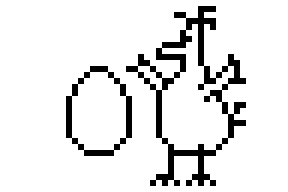
gingicon.bmp gives Ginger just enough room for a comb, eyes, beak, and folded wings. It is enlarged here without smoothing so every source pixel remains visible. The alternative cricon16.bmp is more austere: a red C and R on black.
The two LCD images use the VMU screen’s native 48 by 32 resolution. One does not attempt a logo or a status display. It simply offers an opinion:
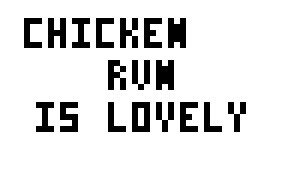
The companion image reduces the film to its essential cast: one chicken and one egg.
The games beneath Chicken Run
The porting layers make more sense when placed beside the older games still visible in the engine. Chicken Run did not begin with an empty repository. Its headers carry a family tree of earlier Blitz projects:
- Frogger 2 -
actor2.c,sprite.c,layout.c,shell.c,gte.c, andfadeout.cretain Frogger 2 titles.main.cstill definesglobalFrogScale, whilefrogedit.datpoints toc:\work\froggerii\leveldump. - Action Man 2 -
islfont.c,language.c, andtimer.care markedAM2. Barry Paterson recorded the Chicken Run language conversion on 27 March 2000.bff_load.ccan still be compiled for either an Action Man 2 or Frogger testbed. - Glover - The platform structures say they were adapted from Glover. A pointer-fixup macro also survives with a comment that it was used there but not in Frogger 2.
- Titan -
lights.ccredits its shadow code to Scott Lamb’sexlightwork in Titan. The include forexlight.his commented out, so the earlier project itself is not part of this copy.
One relic reaches further back. ultra64.h is a Nintendo 64 SDK header carrying a 1994 Silicon Graphics copyright. Neither the Katana nor PSYQ makefile uses it. It is simply an old toolchain layer that was never cleared away.
The simple model shell folder compresses this history into a tiny program. Its makefile builds a Kamui 2 ELF containing little more than the PSI model plotter. There are no chickens, dogs, or medals, yet main.c still calls itself the Frogger 2 shell and dates itself 9 March 2000. Even globalFrogScale remains, set to 2457.
The people in the comments
After the platforms, formats, and inherited code, the archive resolves into individual voices. The final word belongs to the credits: credits.c walks a fixed sequence of string identifiers and gametext.txt supplies the names.
The programming lines appear in this order:
| Role | People |
|---|---|
| Lead programmer | Fred Williams |
| Programming | Tom Drummond, David Harries, Barry Paterson, Chris Wilson |
| Tools programming | James Steele, Chris Wilson |
| Additional programming | Ian Bird, Steve Bond, Scott Lamb, Andy Sidwell, John Whigham |
| Compression technology | Richard Hackett |
Darren Wood is listed as project manager, with Dave Flynn and David Manuel as team leaders. Philip Oliver is managing director and Andrew Oliver technical director. Rob Lord receives the music and sound-effects credit.
The source adds personality that the formal list cannot. Chris Wilson signs the curtain transition with a punchline:
/* Curtains.c - by Chris Wilson
   It's curtains for you, my lad! */
The credits close on their own production statistic: 1284 chicken pies eaten during development.
Reference material
The source analysis ends with one external comparison and the supporting references.
PlayStation GameShark codes
These codes are from a published cheat list, not from a table in the source 2:
- Max Eggs -
800AA1D0 0063 - Have All Map Pieces -
50000901 0000 300AA1F1 0001, for GameShark 2.2 or higher