
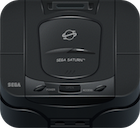
Sega Saturn (Hacking & Reversing)
Edit on Github | Updated: 9th August 2026Introduction to Hacking/Modding/Reversing the Sega Saturn
Welcome to our page dedicated to Sega Saturn reverse engineering! The Sega Saturn was a gaming console released by Sega in 1994, and it introduced several innovative features to the gaming world, such as the ability to play games on both CDs and cartridges. If you’re interested in learning more about the technical aspects of this console and how it works, you’ve come to the right place.
On this page, we’ve compiled a list of links to other pages that cover various topics related to Sega Saturn reverse engineering. Whether you’re interested in understanding the hardware architecture of the console, analyzing game code, or exploring the many mods and hacks that have been created by enthusiasts over the years, you’ll find a wealth of resources and information on the pages we’ve linked to.
So grab your Sega Saturn controller, and get ready to dive into the exciting world of Sega Saturn reverse engineering!
Sega Saturn Exclusives
When it comes to finding a game to reverse engineer it can be helpful to look at games that are cross-platform to compare builds. But the most valuable reverse engineering projects tend to be the platform exclusives as these are games people can no longer play on modern consoles.
Reverse Engineering the Password System in The Lost World: Jurassic Park
In May 2025, reverse engineer Bo Bayles published an in-depth analysis of the password system used in the Sega Saturn version of The Lost World: Jurassic Park. By examining the game’s code with Ghidra, Bayles uncovered previously undocumented cheat codes that unlock features such as invincibility, a stage select screen, and two hidden arcade galleries. These discoveries shed light on the game’s internal mechanics and offer new ways to experience the title nearly three decades after its release.
For a detailed breakdown of the password system and the newly discovered codes, refer to Bayles’ full article:
Sega File Formats
The Sega Saturn was the second released Sega console which used CD-ROM to distribute its games, one of the benefits of the CD-ROM format is many times more space than a cartridge. One of the downsides compared to cartridges however was the slower loading times as reading from a CD is much slower than reading from a ROM chip.
Unlike most cartridge based ROM chips CDs have a standard File System to read files from and so instead of everything being in a giant blob of binary and burned to a chip, the game could be split into multiple files.
Also the consoles would not have enough RAM to hold all the game assets so games would have to stream assets into memory when needed. So it would only read the texture or sound files used in a particular level and ignore the rest.
This makes it slightly easier to do some basic modding of Saturn assets compared to a ROM based console such as the Mega Drive, as you can normally pinpoint the asset you want down to a particular file and sometimes they have file extensions that tell you exactly what format the file is.
Sega Saturn Hardware
If you’re interested in reverse engineering software for the Sega Saturn gaming console, it’s crucial to have a solid understanding of the hardware that powers it. By comprehending the inner workings of the Saturn hardware, you can better understand how the software interacts with the hardware and how you can potentially modify or enhance it.
This section of our guide will provide you with comprehensive information and resources on the hardware of the Sega Saturn, including retail, prototype, and development hardware.
Retail Sega Saturn hardware
When the Saturn was launched it brought incredible processing power into the home with two SH-2 Hitachi processors. The hardware was state of the art but also very complex and hard to program but exploring how it was developed is a fascinating topic.
Retail Saturn Disc Copy Protection
The user jhl on assemblergames has an excellent post on the inner workings of the Saturn DISC protection: https://web.archive.org/web/20170626013038/https://www.assemblergames.com/threads/saturn-copy-protection-and-cdrs-the-conclusive-end.50295/
Saturn Hardware in the Arcade
The Sega ST-V arcade board is basically a Sega Saturn located in an arcade cabinet, some of the games released for the ST-V were also available on the Saturn but others remain exclusive to the arcade hardware.
Development Kits (Hardware)
Development kits are released to game developers before the launch of the system to allow games to be developed for the system’s launch. These systems would evolve over the systems lifespan and contained useful features for debugging and optimizing games for the platform. These systems were not just limited to the official offerings by nintendo as a few other publishers had their own versions of development hardware.
Official Development Kits
The official development kit for the Saturn was a partnership between SEGA and Sophia and the hardware evolved over time. The first development kit released was called the Saturn Programming box or P-box and evolved into the Cart-Dev system.
3rd Party Development Kits
There were a few third party developers who created their own custom development kits for the Sega Saturn. One of the main developers for 3rd party devkits was SN Systems with their Psy-Q Saturn with a much cheaper price tag than an official Sega devkit.
Sega Saturn Software Development Kits
Official Software development kit
The Official Software development kit was developed in-house by SEGA and was made up of multiple libraries and compiler toolchains. One was a fork of GCC built by Cygnus Solutions and the other was a custom compiler built by Hitachi.
Using the SDK - Compiling samples
One of the best ways to get started understanding how games were made using the official SDK is to tinker with the samples that come packaged with the SDK. By compiling and running these on a Saturn console you can start to understand how everything pieces together.
Sega Saturn Graphics
There are some myths around the Sega Saturn’s graphical abilities, such as the lack of transparency support, that can be proven false with some clever programming techniques.
Sega Saturn Alpha Transparency Effects
The Sega Saturn’s unique way of drawing 3D vertices made life very difficult for developers to implement Alpha Transparency techniques such as objects fading into view. Unlike the Sony PlayStation or Nintendo 64, the Saturn’s VDP1 graphics chip did not render true 3D polygons. Instead, it rendered 3D objects as distorted 2D sprites (quads). When developers attempted to apply standard alpha transparency to these overlapping, distorted sprites, it caused massive visual corruption and Z-sorting errors. This is why contemporary Saturn games like Daytona USA had to rely on harsh “pop-in” for distant scenery rather than smooth fading.
Sonic R’s “Impossible” Fading
GameHut has a deep dive into the coding secrets behind the distance fading and alpha transparency effects used in the Sega Saturn game, Sonic R. It covers the specific rendering techniques and hardware workarounds that Traveller’s Tales employed to achieve these seemingly impossible 3D graphical effects on 32-bit architecture.
To make the flat 2D sprites look like 3D objects with simulated volume and lighting, Traveller’s Tales utilized Gouraud shading.
The core problem was that applying Gouraud shading consumed the exact same hardware color calculation pathways needed to render transparency. A developer could have dynamic lighting or transparency, but the Saturn could not natively handle both on a single sprite at the same time.
Stripping the Lighting
To fade an object in from a distance, Burton’s engine first had to mathematically strip away its Gouraud shading to free up the color registers. However, simply turning off the lighting would cause a jarring visual pop on the textures. To mask this transition, the engine stored and calculated three distinct sets of lighting data simultaneously. As an object entered the draw distance, the game bridged the unlit texture with the shaded texture, creating a smooth visual transition before the full lighting was officially disabled.
The 8-Register Fade
Once the Gouraud shading was successfully stripped from the distant polygons, the hardware pathways were freed up. The engine then hijacked the Saturn’s 8 available color calculation ratio hardware registers. By tying these 8 transparency levels to the in-game camera’s Z-depth (distance), the now-unlit polygons could cycle through 8 distinct stages of alpha blending.
The Result
As a piece of the track approaches the camera, it smoothly fades into existence through 8 steps of transparency. Once it becomes fully opaque and gets close enough to the player, the engine dynamically reapplies the Gouraud shading. This two-part swap happens entirely in the background, tricking the player’s eye and creating a smooth draw distance that most developers considered fundamentally impossible on the Sega Saturn architecture.
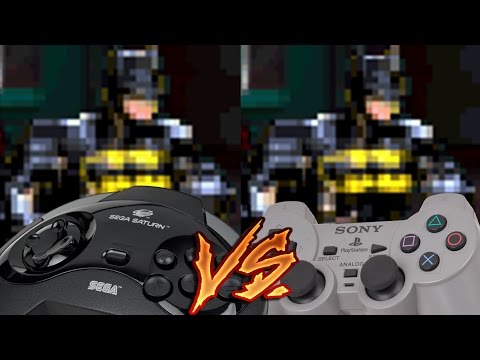
As the name suggests Batman Forever is originally an Arcade Game that got ported to MS-DOS, the Playstation 1 and Sega Saturn by Iguana Entertainment (Acclaim Published).
The original arcade release was for the ST-V (Sega Titan Video Game System)...
...
If you are interested in reversing a Sega Saturn game it can be useful to see what other platforms the game was released for, however if you don’t have a game in mind then this list can help you choose... ...
Introduction to PSY-Q Saturn The PsyQ Sega Saturn development kit was developed by a partnership of Psygnosis and SN Systems in order to make it really easy to develop for both the Sega Saturn and PS1 using the same sort... ...
SYSROF Object Module Format The SYSROF format was commonly used in the early 90s by companies like Hitachi for their own compiler toolchain instead of other formats such as COFF or ELF.
The SYSROF format is most common in the...
...
The Sega Saturn SDK comes with pre-build static libraries such as SEGA_GFS which are required to interact with the Saturn hardware and provides a nice extraction layer .
There are two standard GNU (.a) and Hitachi (.lib).
The Sega Saturn...
...
Disassembling the executable According to a post on segaxtreme.net the Sega Saturn executes the first file it find on the disc, most of the time its in the root directory in alphabetical order.
Loading into IDA Pro Use a save...
...
This post will cover the most commonly used tools by artists when developing assets for Sega Saturn games, including 2D, 3D and Video.
2D Art Software The Sega Saturn had multiple tools available for 2D asset creation, most were third...
...
The Sega Saturn was the second released Sega console which used CD-ROM to distribute its games, one of the benefits of the CD-ROM format is many times more space than a cartridge.
One of the downsides compared to cartridges however...
...
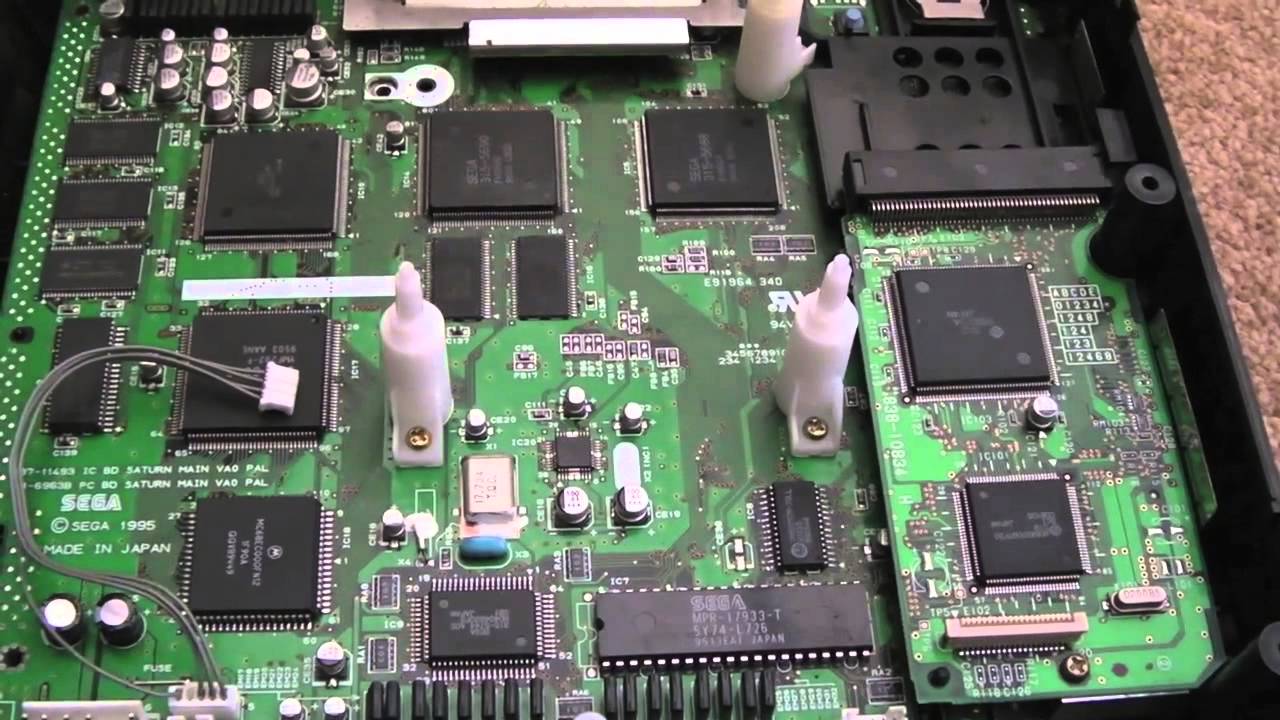
Image from EDGE magazine issue 23 2x Hitachi SH·2s @28.6MHz, 25 MIPS 16Mbit SDRAM for SH2s 12Mbit SDRAM for VRAM and frame buffer 512K sound DRAM for 68ECOO 32K SRAM for battery back·up 512K IPL (initial program loading) ROM -... ...
Hitachi released a toolchain for Sega Saturn development, this is an alternative to the GNU toolchain also available from Sega.
Executables The table below lists the relevant entries.
Executable Description asmsh.exe SH Assembler binadj.exe cnvs.exe SYSROF STYPE OBJECT CONVERTER...
...
There are multiple ways to create your own Homebrew for the Sega Saturn, one is to use the official SDK but a much better way is to use one of the open-source modern development kits available.
libYaul LibYaul is an...
...
The first 15 sectors (32KB) of a SEGA Saturn CD contains the Boot System Initial Program code known as IP.BIN 1.
In this post we will explore what it is, the purpose of it and how it works.
What is...
...
Main memory Map The table below highlights the main areas that can be accessed in Sega Saturn games.
Start End Name Description 0x00 0x000FFFFF Boot ROM Repets every 512 kb 0x00100000 0x0017FFFF SMPC registers 0x00180000 0x001FFFFF Backup RAM ...
...
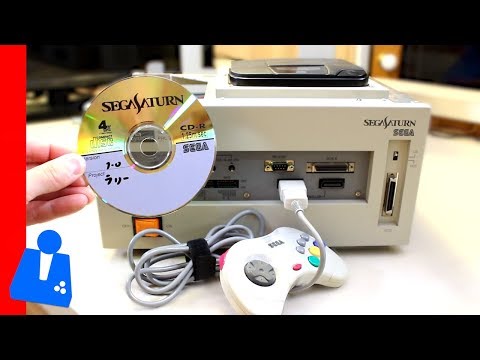
During the Sega saturns lifecycle there were multiple development kits available to developers starting from the original Sphia Systems that came out before the retail hardware, followed by devkits from both Cross Products (Official) and the Unofficial SN Systems (PSYQ).... ...
Introduction The Sega Saturn Reversing Emulator (RE) is a fork of the Beetle Sega Saturn emulator tailored for reverse engineering.
The main aim is to generate information that will be useful for the disassembling and decompilation of your chosen game....
...
The Sega Saturn Software Development Kit was available for both PC and SGI workstations and consisted of a number of libraries build in-house by Sega and a few custom 3rd party.
{% include_cached link-to-other-post.html post=”/sega-saturn-programming-box” description=”For the hardware side of...
...
This guide will walk you through compiling the official Sega Saturn samples which are part of the Sega Basic Library.
Building START (STRT) library This needs to be built before any of the samples as it contains common code for...
...
The Sega Saturn has multiple ways to persist game data across play throughs.
This includes built in memory on the Saturn console itself and official and 3rd party cartridges that acted as memory cards.
Note that these are not the...
...
{% include file-parser.html format=”YSS” %} The emulator Yabause uses a simple format to save the state of the emulated machine, drag and drop a .yss file below and you will be able to see what each of the bytes mean.... ...