
Introduction
Nintendo’s 3DS arrived in 2011 with a glasses-free stereoscopic upper screen and a touch screen below it 1. For anyone taking apart a game, those two displays are only the visible part of the system: ARM11 software, a separate ARM9 security processor, PICA200 graphics, and several layers of cartridge files all have their own roles 2. This hub connects the hardware, development equipment, game formats, and early homebrew work to the more detailed guides below.
Why do some documents call it Citrus or CTR?
The 3DS followed the Nintendo DS (NITRO) and DSi (TWL). Its development material often uses CTR, while file-format names expand it as Citrus - for example, CTR Cart Image (CCI) and Citrus Executable Image (CXI) 3. The names are useful search terms when a tool, board, or file does not say “3DS” outright.
Hardware
The Nintendo 3DS hardware analysis by Rodrigo Copetti traces the processors, graphics pipeline, memory, and security model. Start there when a register access, display behavior, or executable’s privilege level needs more context 2.
How did stereoscopic 3D change the graphics workload?
The upper display presents a separate 400 x 240 view to each eye; the lower display adds another 320 x 240 image 2. In Iwata Asks: The Hardware Concept, Nintendo’s engineers describe the practical consequence: supporting 3D meant producing three images, while the brighter backlight also consumed power. Their choice of Digital Media Professionals’ graphics technology was shaped by that power budget 4. When investigating a game’s rendering, it helps to ask whether a scene is drawn twice for stereo or shown only on the lower screen.
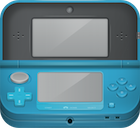
Retail Nintendo 3DS Hardware
Copetti’s diagrams also distinguish the ARM11 application side from the ARM9 side and explain how both relate to older DS software 2. The article is a useful companion to a disassembly because a 3DS game does not have direct control over every component in the machine.

What did 3DS development hardware look like?
The development hardware guide collects photographs and documentation of early CTR target boards and later Partner-CTR equipment. The exposed prototype board is especially helpful for seeing how the two screens and development connections were arranged before the final handheld shell.
Games and Homebrew
Where are a game’s code and assets stored?
A 3DS game card image uses an NCSD header to describe its partitions. Those partitions contain NCCH files: an executable CXI can hold ARM11 code in ExeFS and game data in RomFS, while a CFA is non-executable content 5. This is why opening a cartridge image is only the first step toward finding the program or the files it loads. The 3DS file formats guide maps the extensions and containers you are likely to encounter.
How did early 3DS homebrew get started?
The ninjhax source repository shows one route from a game’s QR-code reader to unsigned homebrew. Its README identifies the initial Cubic Ninja QR loader, the secondary payload, and the homebrew menu; the project also links to the author’s technical write-up 6. The Tech Rules video tells the story of this early hacking period, including the unlikely role of that game.
Magazine Interviews
The magazine index collects developer interviews tagged for this system across all indexed magazines.
| Magazine | Issue | Pages | Developer | Platforms | Description |
|---|---|---|---|---|---|
| Retro Gamer | 135 | pp. 22-31 | Pokémon developers | Game Boy, Nintendo DS, Nintendo 3DS | Game Freak developers discuss the evolution of Pokémon. |
| Retro Gamer | 148 | p. 54 | Yosuke Okunari | Mega Drive, Nintendo 3DS | The Sega producer discusses converting Gunstar Heroes for the 3D Classics range. |
| Retro Gamer | 168 | pp. 86-89 | Hitoshi Yamagami, Toshiyuki Kusakihara and Masahiro Higuchi | Nintendo 3DS | The developers discuss remaking Fire Emblem Gaiden as Echoes. |
| Retro Gamer | 174 | pp. 88-91 | Yoshio Sakamoto and Jose Luis Márquez | Nintendo 3DS | The producer and codirector discuss developing Metroid: Samus Returns. |
All Posts

Official Development kits Nintendo’s official 3DS development hardware was created in collaboration with Intelligent Systems (IS) and Kyoto Microcomputer Co..
CTR-TEG2 - CTR Target Board - Prototype Hardware The earliest known 3DS dev kit was a bare-bones prototype board used...
...

The Nintendo 3DS (Codename CITRUS) utilises a number of different file formats either created by Nintendo or third party.
If you are interested in reverse engineering a 3DS game then you will most likely come across these formats, so it...
...

Awesome list of Obscure Handheld Game Development and Reverse Engineering information ...

The Ninja leak occurred on the 22nd December 2020 and is named after the contents containing information that prove the long-standing Nintendo “Ninja” myth.
Including stalking and intimidation of a Nintendo 3DS developer who is well respected in the scene...
...

Nintendo has has many data leaks in the past, but none as huge as the original Oman Archive of the late 90s or the Gigaleaks of 2020.
This post is a reference point to help people catch up on any...
...

The Paladin leak occurred on the 30th of September 2020 and included about 2.4GB of content related to the Nintendo IRIS and Pokemon spinoffs.
This was the third Nintendo leak in September 2020 with the First being the Emerald leak...
...

Have you ever seen Twitch Plays Pokemon (TPP) and wondered how it actually works?
How does typing comments in a twitch stream result in the player moving in the original Pokemon Games, how is the screen directly streaming to twitch...
...