
The Nintendo 64 operating-system SDK shipped small source projects that taught developers how to draw a first frame, schedule audio and graphics, use controllers and storage, and measure the hardware. The examples changed across releases: new peripherals gained samples, some older projects moved to a separate directory, and familiar folder names often held revised files 1 2.
Two development archives preserve earlier working copies. The Oman archive has samples in both APPS and usr/src/PR. A Project Reality (PR) tree beside the Turok: Dinosaur Hunter source holds many of the same projects. Their shared 2.0G release notes identify an early SDK base, but neither tree is an untouched distribution 3. This guide compares those copies with the supplied 2.0H, 2.0I, 2.0J, and 2.0L packages.
The wider libraries and development tools are covered in the SDK overview:

Key terms
The SDK uses these abbreviations throughout its source and notes:
- RSP - Reality Signal Processor, which runs graphics and audio microcode.
- RDP - Reality Display Processor, which rasterizes graphics commands.
- RCP - Reality Coprocessor, which includes the RSP and RDP.
- LOD - Level of detail, selecting a model or texture representation for its screen size or distance.
Where are the SDK demos?
The dated evidence and sample coverage place the development copies beside four packaged releases. Dates refer to bundled notes or readmes, not necessarily to when every file was created. Folder counts include the shared Texture asset directory; Oman’s APPS count covers same-named inventory folders, while its other locations are listed separately 4 5 3 6 7 8:
| Copy | Dated evidence | Inventory coverage | Character of the copy |
|---|---|---|---|
| Oman | 2.0G base, 30 September 1996 | 28 APPS folders; 5 in usr/src/PR; Tron in NTRON.SKIP |
Developer archive with more than one sample tree |
| Turok | 2.0G base, 30 September 1996 | 38 inventory folders | PR working tree with retained build output |
| OS-PC 2.0H | PC readme dated 19 March 1997 | 40 direct folders | Earlier PC source layout, including 64DD examples |
| OS-Library IRIX 2.0I | Notes dated 15 December 1997 | 44 main folders | Reorganized demos tree |
| OS-PC-SGI 2.0J | Notes dated 1 February 1999 | 43 main + 5 older folders | More peripheral examples; older projects retained separately |
| OS-PC 2.0L | Notes dated 3 July 2000 | 44 main + 7 older folders | Flash, S2DEX2, and profiling examples |
The supplied disc photographs show two editions from the later part of this sequence. The gold label identifies the IRIX 2.0I release. The teal disc is labelled OS/SGI 2.0L, while the 2.0L inventory below was checked against a separate OS-PC 2.0L package 9 2 10.
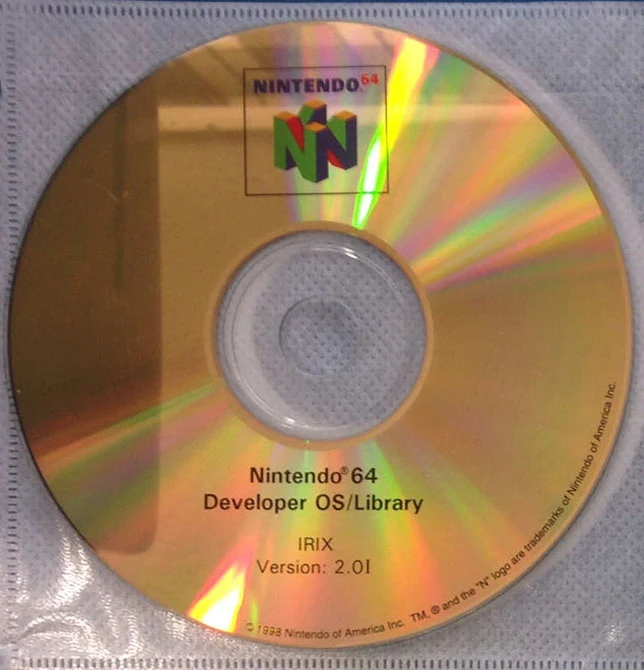
The supplied OS/Library IRIX 2.0I disc photograph. This edition’s demo tree is compared in the inventory. Select the image for a larger view.
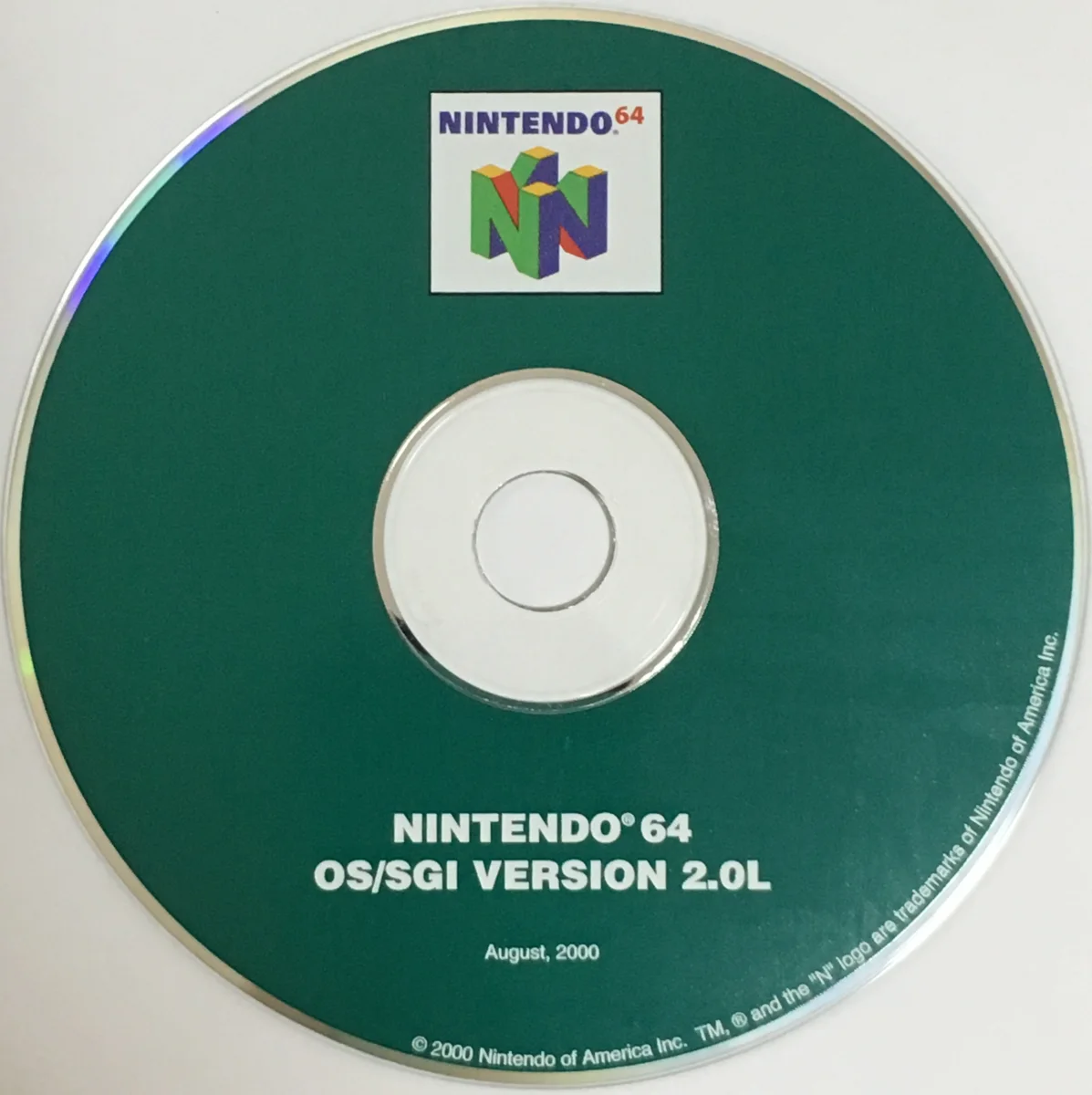
The supplied OS/SGI 2.0L disc, labelled August 2000. The 2.0L inventory column describes the separate OS-PC edition. Select the image for a larger view.
The 2.0G attribution for Oman and Turok comes from byte-identical release notes in the two archives. It identifies a base version, not the age or revision of every project. Turok’s PR tree also contains Iguana’s tengine and compiled demo output. Those files show a working development tree; a sample’s presence beside the game does not establish that it was compiled into Turok 1 3.
How did the collection change?
The 2.0H PC package still places projects directly in USR/SRC/PR. Its notes describe nnsample1 as a scheduler example and nnsample2 as an F3DEX and LOD example. The package also has a Rumble Pak test, a 64DD font sample, and a disk variant of tile_rect3d 6.
The 2.0I IRIX release groups the examples under usr/src/PR/demos. Its notes identify gs2dex, eeptest, and sramtest as new samples. It also includes cptest, greset, print, and spin, projects familiar from the earlier working trees 9 11.
greset helps explain why a dash in one release need not mean the lesson disappeared. Oman, Turok, and IRIX 2.0I have byte-identical source that opens IRIX’s /dev/mmem and writes the SGI board’s reset-control register. The 2.0H PC archive documents greset but has no program files for it; its PC readme instead shows a Partner-N64PC reset command. The platform difference is a plausible reason for the omission, although the installer does not say why 12.
By 2.0J, examples for 64DD, the Transfer Pak, and voice recognition appear in the inspected PC collection. gtdemo, host_test, hostio, simple, and turbomonkey sit in demos_old rather than the main folder; they remain available. In 2.0L, nnsample1 and nnsample2 join them there, while flash, spritemonkeyEX, and threadmonkey appear in the main set. The last three cover Flash ROM testing, S2DEX2 sprites, and thread profiling 13 2 14.
These are source distributions, with assets and build files alongside the C code. Some projects need the shared Texture directory. The 2.0L guide names eight that depend on it, including mipmap and spgame 2.
Official demo inventory
The table shows which inspected copies contain each sample. Yes means a same-named folder is present; Oman’s Yes (/PR) locates a project in its separate usr/src/PR tree, and Yes (NTRON.SKIP) identifies its Tron source under that name. Old means a later PC release places the project in demos_old. A dash means the project was not found in the compared locations; it does not rule out related code elsewhere. The descriptions summarize the supplied guides and source. Texture is shared data, not an application 1 13 2 9 5 6 7 8:
| Folder | What it demonstrates | Oman | Turok | 2.0H | 2.0I | 2.0J | 2.0L |
|---|---|---|---|---|---|---|---|
autofill |
Triangle fill-rate measurement | Yes | Yes | Yes | Yes | Yes | Yes |
blockmonkey |
Display-list and rendering performance | Yes (/PR) | Yes | Yes | Yes | Yes | Yes |
bumpmap |
Bump mapping | Yes | Yes | Yes | Yes | Yes | Yes |
chrome |
Reflection mapping | Yes (/PR) | Yes | Yes | Yes | Yes | Yes |
ci8fb |
8-bit color-index frame-buffer rendering | Yes (/PR) | Yes | Yes | Yes | Yes | Yes |
cptest |
Small C++ application and runtime support | Yes (/PR) | Yes | - | Yes | - | - |
ddspgame |
64DD commands and error handling | - | - | - | - | Yes | Yes |
detail |
Multitiling, detail textures, and mipmaps | Yes | Yes | Yes | Yes | Yes | Yes |
eeptest |
4 Kbit and 16 Kbit EEPROM tests | - | - | - | Yes | Yes | Yes |
fault |
CPU fault-event handling | Yes (/PR) | Yes | Yes | Yes | Yes | Yes |
flash |
1 Mbit Flash ROM tests | - | - | - | - | - | Yes |
font |
64DD mask-ROM font data access | - | - | Yes | - | - | - |
fogworld |
Fog and volume culling | Yes | Yes | Yes | Yes | Yes | Yes |
gbpak |
Transfer Pak access to a Game Boy cartridge | - | - | - | - | Yes | Yes |
ginv |
CPU, RCP, and memory inventory | Yes | Yes | Yes | Yes | Yes | Yes |
gl |
Partner-N64 game loader | - | - | - | - | Yes | Yes |
greset |
Host-side development-board reset utility | Yes | Yes | - | Yes | - | - |
ground |
Clipping a large ground plane | Yes | Yes | Yes | Yes | Yes | Yes |
gs2dex |
S2DEX sprite microcode | - | - | - | Yes | Yes | Yes |
gtdemo |
Animated characters and turbo graphics tasks | Yes | Yes | Yes | Yes | Old | Old |
host_test |
Host-to-target data transfer using osReadHost and osWriteHost |
- | - | Yes | - | Old | Old |
hostio |
Indy-to-target data exchange | Yes | Yes | Yes | Yes | Old | Old |
lights |
Specular lighting and simulated shadows | Yes | Yes | Yes | Yes | Yes | Yes |
mipmap |
Texture filtering and mipmap comparison | Yes | Yes | Yes | Yes | Yes | Yes |
morphcube |
CPU vertex morphing alongside graphics tasks | Yes | Yes | Yes | Yes | Yes | Yes |
morphfaces |
Two-dimensional image morphing and blending | Yes | Yes | Yes | Yes | Yes | Yes |
motortest |
Rumble Pak control | - | - | Yes | Yes | Yes | Yes |
nnsample1 |
Nintendo scheduler and graphics tasks | - | - | Yes | Yes | Yes | Old |
nnsample2 |
F3DEX 1.21 LOD and microcode loading | - | - | Yes | Yes | Yes | Old |
nosPak |
Controller Pak menu with Nintendo font data | Yes | Yes | Yes | Yes | Yes | Yes |
onetri |
Single-polygon rendering | Yes | Yes | Yes | Yes | Yes | Yes |
onetri-fpal |
Full-screen PAL version of onetri |
- | - | - | - | Yes | Yes |
overlay |
Reusing RAM with code and data overlays | Yes | Yes | Yes | Yes | Yes | Yes |
pfs |
Controller Pak file-system operations | Yes | Yes | Yes | Yes | Yes | Yes |
playseq |
Audio sequence player | Yes | Yes | Yes | Yes | Yes | Yes |
playseq.naudio |
Sequence player using n_audio |
- | - | - | - | Yes | Yes |
polyline |
Switching polygon and line microcode | Yes | Yes | Yes | Yes | Yes | Yes |
print |
osSyncPrintf performance with and without osInitRdb |
Yes | Yes | - | Yes | - | - |
reboot |
Starting a disk program from a Game Pak | - | - | - | - | Yes | Yes |
simple |
Graphics, audio, input, and task scheduling | Yes | Yes | Yes | Yes | Old | Old |
soundmonkey |
Sequence and sound players with voice limits | Yes | Yes | Yes | Yes | Yes | Yes |
spgame |
Foreground and background sprites | Yes | Yes | Yes | Yes | Yes | Yes |
spin |
Interactive RCP and RDP graphics controls | Yes | Yes | - | Yes | - | - |
spritemonkey |
Sprite2D microcode | Yes | Yes | Yes | Yes | Yes | Yes |
spritemonkeyEX |
S2DEX2 sprite microcode | - | - | - | - | - | Yes |
sramtest |
256 Kbit SRAM tests | - | - | - | Yes | Yes | Yes |
terrain |
Controller-driven terrain editor | Yes | Yes | Yes | Yes | Yes | Yes |
texlight |
Diffuse and specular lighting on textured objects | Yes | Yes | Yes | Yes | Yes | Yes |
threadmonkey |
Thread profiler | - | - | - | - | - | Yes |
tile_rect2d |
Tiled texture rectangles | - | Yes | Yes | Yes | Yes | Yes |
tile_rect3d |
Seamless tiled triangles | - | Yes | Yes | Yes | Yes | Yes |
tile_rect3d.disk |
64DD version of tile_rect3d |
- | - | Yes | - | - | - |
topgun |
Geometry converted from a MultiGen .flt model |
- | Yes | Yes | Yes | Yes | Yes |
tron |
Transparent walls and an RDP hang workaround | Yes (NTRON.SKIP) | Yes | Yes | Yes | Yes | Yes |
turbomonkey |
Turbo graphics microcode performance | - | Yes | Yes | Yes | Old | Old |
voice |
Japanese-language speech-recognition sample | - | - | - | - | Yes | Yes |
Texture |
Shared textures for other demos; not an app | Yes | Yes | Yes | Yes | Yes | Yes |
Oman has five projects only in its usr/src/PR tree: blockmonkey, chrome, ci8fb, cptest, and fault. Its APPS/NTRON.SKIP folder is a Tron project: the Makefile sets APP = tron and builds TRON.C. A search across the extracted Oman tree found references to tile_rect2d, topgun, and turbomonkey, but no demo source for those three 7 8.
How closely do Oman and Turok match?
The inventory contains 33 demo projects present in both archives, counting Oman’s alternate PR and NTRON.SKIP paths but excluding the shared Texture asset folder. Only overlay, polyline, and print are byte-identical as complete folders. In seven more projects, every Oman file matches a Turok file at the same relative path, but Turok has additional files. Across all 33 projects, 29 have at least one exact file match 15.
The Oman archive viewer shows the wider directory tree, including the SDK examples and hardware verification programs:

The seven projects with extra Turok files are ginv, greset, gtdemo, hostio, onetri, simple, and soundmonkey. Their 106 extra files are mostly object files, ROM images, executables, dependency files, and build maps. GTDEMO also retains generated walktable and punchtable tools and headers. These build products explain why a folder can contain the same source as Oman without being identical as a whole 15.
Other matches are partial. Oman’s chrome shares four texture files with Turok, while its nine corresponding source and build files differ. mipmap matches on 53 of 54 Oman files. Release labels matter too: onetri has the same 11 relative file paths in the 2.0J and 2.0L packages, but only one file is byte-identical across those two versions 16 13 2 7.
The Turok source analysis explains the game engine and build environment surrounding its copy of the PR samples:
 (Rev B) 1.png)
What do the demos teach?
The collection starts with the structure of a running frame, then moves into rendering, host communication, audio, and peripherals. The source is useful even when a sample’s on-screen result is simple.
A first frame, memory overlays, and scheduling
ONETRI draws spinning triangles. Beyond the geometry, it sets up threads, message queues, graphics output, and a ROM spec file. OVERLAY extends that pattern by placing alternative code and data segments in the same RAM space at different times. Together they show the basic program structure and one way to reuse limited memory 17.
SIMPLE joins graphics, controller input, music, and sound effects. It gives audio work higher scheduling priority because a missed audio deadline is audible, while graphics can repeat a frame. nnsample1 later provides a different scheduler implementation for developers studying how to coordinate graphics tasks 18 14.
Texture filtering, graphics tasks, and measurement
MIPMAP compares point filtering, bilinear filtering, generated mip levels, and prepared mip levels in four views. Its controller menu changes the texture and scale so the difference becomes visible 19. The brick images below are two original SGI-format inputs from Oman, converted losslessly for the article. They are textures, not screenshots from a running console:

APPS/MIPMAP/BRICK.RGB, 32 x 32 pixels. The higher-detail input for the sample’s comparison.

APPS/MIPMAP/BRICK2.RGB, 8 x 8 pixels. A smaller level is selected when the surface occupies fewer screen pixels.
GTDEMO combines animated characters, a punch action, and turbo graphics tasks. It exposes timing bars for CPU and RCP work. AUTOFILL narrows the question to triangle fill rate: it varies triangle shape and count, then records timing data for plotting. The pair shows how SDK examples could teach both visible effects and measurement methods 20 21.
Other rows isolate one rendering choice: chrome uses reflection mapping, fogworld combines fog with volume culling, and tile_rect3d tiles large surfaces without visible seams 1 6.
Sprites and audio
SPGAME builds a scene from a background, moving ball sprites, and sprite-rendered text. Its build file converts the source images with mksprite; the program draws seven ball objects 22. The two images below are source assets, not captured frames:
From APPS/SPGAME/TEXTURE/L2_TV.RGB. The build file turns this 320 x 240 image into sprite data.

From APPS/SPGAME/TEXTURE/BALL.RGBA. The sample moves seven instances of this sprite.
The sample family also tracks graphics microcode changes. spritemonkey demonstrates Sprite2D, gs2dex covers S2DEX, and 2.0L’s spritemonkeyEX uses S2DEX2. For audio, playseq demonstrates sequence playback while soundmonkey exercises sequence and sound players with voice limits 2 9.
Host tools, controllers, and storage
TERRAIN lets a developer edit hills with the N64 controller and save generated terrain data back to an SGI Indy. Its README distinguishes launching the host-side editor from loading only the ROM. HOSTIO is a smaller host-to-target communication example 23 1.
Other projects test the edges of the system: pfs exercises Controller Pak files, motortest controls the Rumble Pak, and eeptest, sramtest, and flash test different save-memory devices. print measures osSyncPrintf with and without osInitRdb, making a host debug facility into a timing experiment 2 9.
Beyond the OS demo collection
The N64 Developers Toolkit 5.2 disc is labelled August 2000. Its later examples are organized separately: NuSystem/sample includes projects such as nuoverlay and nulod; other packages contain HVQ video and sound-tool samples. These complement the operating-system demos rather than replacing the collection above 24 25.
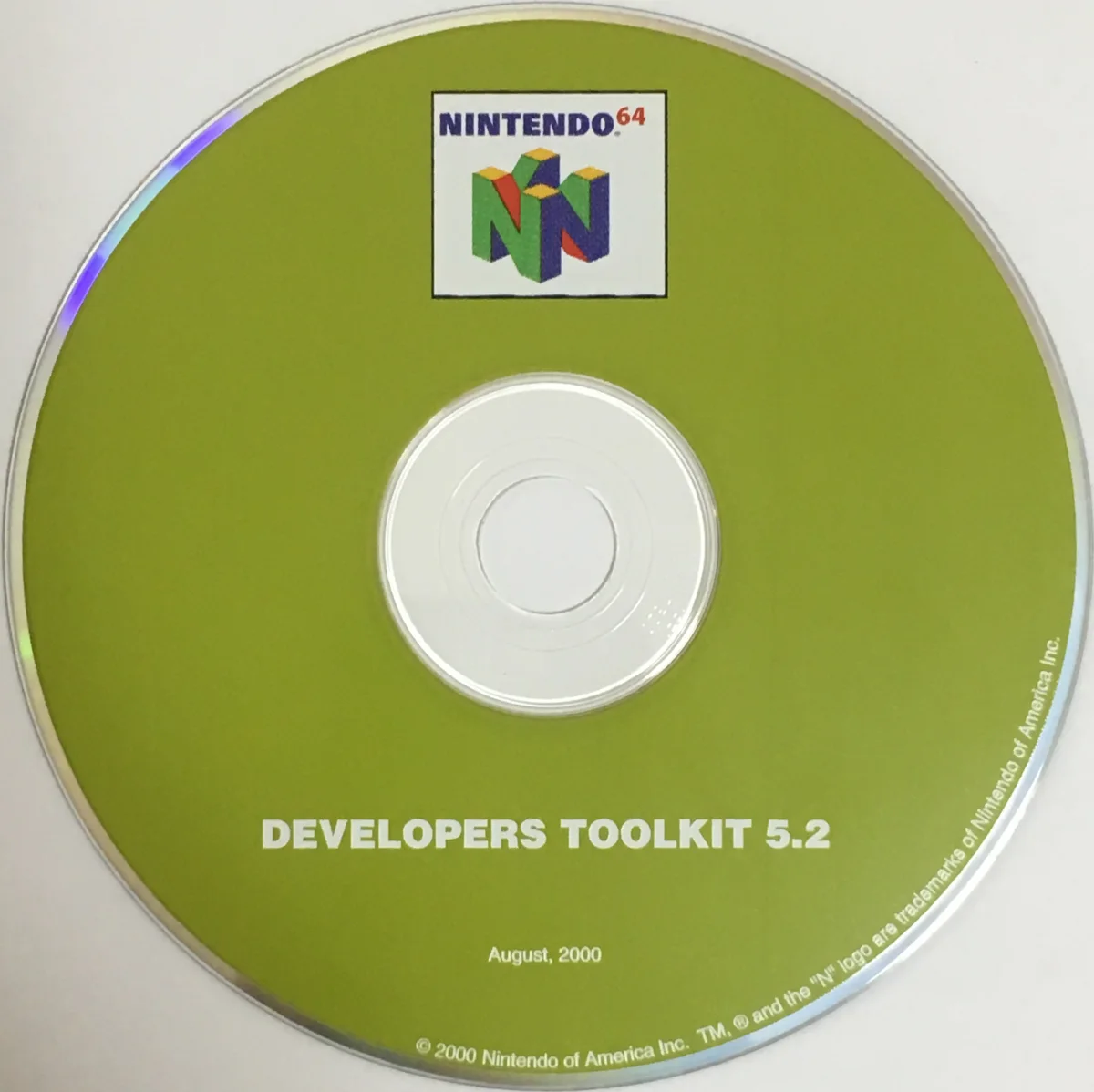
The supplied Toolkit 5.2 disc photograph. Its label reads August 2000. The NuSystem, HVQ, and sound-tool examples are outside the OS demo inventory. Select the image for a larger view.
The Oman archive viewer indexes its wider APPS tree, including hardware tests outside this catalog. The Turok source analysis explains the adjacent game engine and build environment.
References
-
Turok source copy,
src/PR/README_DEMOS, inspected in the supplied archive. It describes 35 named demo applications. This file is not a distribution manifest for every Nintendo 64 SDK version. ↩ ↩2 ↩3 ↩4 ↩5 -
Supplied Nintendo 64 OS-PC v2.0L,
os20l_eng.execontainingdata1.cab, extractedUltra_Dev_Demo/usr/src/PR/. Itsdemos/README_DEMOS.txtexplains the applications, shared textures, and build modes. Thedemosdirectory has 44 immediate subdirectories anddemos_oldhas seven. ↩ ↩2 ↩3 ↩4 ↩5 ↩6 ↩7 ↩8 -
Turok
src/PR/relnotes, OmanMAN/RELNOTES, and OmanMAN/RELNOTES_OLD/RELNOTES.093096are byte-identical (MD526eb7b01c4a239093abaecb195ccf0bf). Their header saysSeptember 30 releaseand identifies Ultra 64 version2.0G for RCP 2.0; the N64 OS release-note chronology dates 2.0G to 1996. These notes identify a release present in the archives, not a verified version or creation date for every other file in either tree. ↩ ↩2 ↩3 -
The supplied IRIX v2.0I
os20i/relnotes20I.txtis headed12/15without a year; n64os-info’s release-note chronology identifies it as 1997. The supplied 2.0Jrelnotes20J.jpis dated02/01/99, and 2.0Lrelnotes20L.txtis dated07/03/00. These are dates printed on release notes, which may differ from actual distribution dates. ↩ -
Inventory presence check of the extracted IRIX v2.0I
usr/src/PR/demos, PC v2.0J and v2.0LUltra_Dev_Demo/usr/src/PR/demosanddemos_old, Turoksrc/PR, and Omanoman/APPS. Immediate directory names were compared without case sensitivity. Thehost_testdescription was checked against v2.0Ldemos_old/host_test/game.c. ↩ ↩2 -
Supplied Nintendo 64 OS-PC v2.0H,
N64os20h.z, extracted with unshieldv3. Its 2,056 archive entries includeUSR/SRC/PR/with 40 immediate example or shared-asset directories and oneDocdirectory.readme.20hprints1997.3.19 2.0H(PC);relnotes.20hidentifies the release as 2.0H and lists the new examples.USR/SRC/PR/README_DEMOS_64DDdescribesFONTandTILE_RECT3D.DISK. ↩ ↩2 ↩3 ↩4 -
Inventory check of the supplied Oman
oman/APPSandoman/usr/src/PRdirectories.blockmonkey,chrome,ci8fb,cptest, andfaultappear directly underusr/src/PRbut notAPPS. All 13 files in Omanusr/src/PR/chromehave same-named relative paths in Turoksrc/PR/chrome. Complete-file MD5 matches forTexture/gameday.rgb,mahogany.rgb,metallic.rgb, andsmroad.rgb; the other nine files do not match byte for byte. ↩ ↩2 ↩3 ↩4 -
Full extracted Oman tree searched for exact demo directory names and filename stems, plus text references to
tile_rect2d,topgun, andturbomonkey.APPS/NTRON.SKIP/MAKEFILEnamestronas its application and includesTRON.C; itsCFB.C,DYNAMIC.C, andZBUFFER.Chave complete-file MD5 matches in Turoksrc/PR/tron.APPS/PFS/MAIN.Clists the other three names as Controller Pak menu labels.TOOLS/CONV/FLT2C.Calso mentions Topgun in a comment. ↩ ↩2 ↩3 -
Supplied N64 Developers OS-Library IRIX v2.0I,
os20i/dist/ultra.idbandultra.dev. All 3,040 indexed files were extracted, including 771 files inusr/src/PR/demosand 44 immediate demo folders includingTexture. The project descriptions above were checked againstcptest/README,greset/greset.c,print/print.c, andspin/READMEin that extracted tree. ↩ ↩2 ↩3 ↩4 ↩5 -
Supplied disc photographs
Nintendo_64_Developers_OS-Library_IRIX_v2.0I.jpgandNintendo_64_OS-SGI_v2.0L.jpg. The latter disc label readsOS/SGI, version2.0L, andAugust, 2000; the 2.0L source distribution analyzed for the inventory is the separately supplied OS-PC package described in 2. ↩ -
Supplied OS-Library IRIX v2.0I,
os20i/relnotes20I.txtandReadme_first.txt. The notes identify the reorganizedusr/src/PR/demospath and namegs2dex,eeptest, andsramtestas new examples in 2.0I. ↩ -
The complete 2.0H
N64os20h.zfile list hasMAN/demoinfo/greset.htmlandUSR/SRC/PR/README_DEMOS, but nogresetsource or executable. Itsreadme.20hshowsuhPartnerCmd(hfd, "rd FILENAME, 0xb0000000\nreset\ng\n"). OmanAPPS/GRESET/GRESET.C, Turoksrc/PR/greset/greset.c, and IRIX 2.0Iusr/src/PR/demos/greset/greset.chave the same complete-file MD5,f35b2e68ae1b0edd7aceff16c6e737b4. ↩ -
Supplied Nintendo 64 OS-PC-SGI v2.0J,
PC/DATA1.CAB, extractedUltra_Dev_Demo/usr/src/PR/. Thedemosdirectory has 43 immediate subdirectories anddemos_oldhas five. ↩ ↩2 ↩3 -
OS-PC-SGI v2.0J,
demos/nnsample1/README.ASCIIanddemos/nnsample2/README.ASCII. ↩ ↩2 -
Complete-folder comparison of 33 inventory demo projects found in both Turok
src/PRand OmanAPPS,usr/src/PR, orAPPS/NTRON.SKIP. Relative file paths were matched without case sensitivity; equal-length files counted as identical only when their complete-file MD5 matched. Incidental.DS_StoreandThumbs.dbfiles were excluded. Three projects have identical file sets and contents; ten have every Oman file represented identically in Turok, seven of those with 106 additional Turok files; 29 share at least one exact file. Thegtdemo/Makefilegenerateswalktable.handpunchtable.hfrom their named helper programs. ↩ ↩2 -
File comparison of the supplied Turok
src/PRand Omanoman/APPStrees. Folder and relative file paths were matched without case sensitivity; only pairs with equal byte length and identical MD5 of the complete file were counted. Incidental.DS_Storefiles were excluded from the comparison. ↩ -
Oman
APPS/ONETRI/ONETRI.C,APPS/OVERLAY/OVERLAY.C, and corresponding identical files in Turoksrc/PR/onetriandsrc/PR/overlay. ↩ -
Oman
APPS/SIMPLE/SIMPLE.C, also identical to Turoksrc/PR/simple/simple.c. ↩ -
Oman
APPS/MIPMAP/READMEand the project’s texture files; the Turok copy contains matching source and textures but no top-levelmipmap/README. ↩ -
Oman
APPS/GTDEMO/README, identical to Turoksrc/PR/gtdemo/README. ↩ -
Oman
APPS/AUTOFILL/README, identical to Turoksrc/PR/autofill/README. ↩ -
Oman
APPS/SPGAME/MAKEFILEandSPGAME.C, identical to the corresponding files in Turoksrc/PR/spgame. ↩ -
Oman
APPS/TERRAIN/README, identical to Turoksrc/PR/terrain/README. ↩ -
Supplied N64 Developers Toolkit v5.2, extracted PC InstallShield cabinets
basic/data1.cab,hvq/data1.cab, andSndTools/data1.cab. The corresponding sample folders were inspected after extraction. ↩ -
The supplied
Nintendo_64_Developers_Toolkit_v5.2.jpgshows the original disc label readingAugust, 2000. No more precise release date is established by that label. ↩