
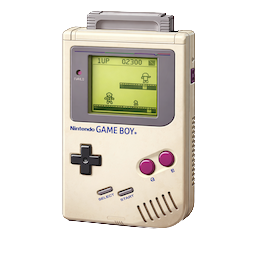
Official Game Boy Software Development Kit (by Intelligent Systems)
The official Game Boy development kit was developed by Intelligent systems and sold with their development kit hardware such as the DMG-ICE. It evolved over time and added support for the Game Boy Color, eventually becoming the SDK shipped with the IS-CGB-EMULATOR hardware.
Using the SDK
If you are interested in using the SDK to develop homebrew or to help reverse engineer a game that used the Official SDK then this section will guide you through some of the basics.
Download the Official Game Boy Color SDK
You can download the Japanese version of the Game Boy Color SDK from emuparadise here: Game Boy Color SDK
Documentation
The official manual for the Software Development Kit was uploaded to archive.org and is available here: Game Boy Development Manual V1.1 : Nintendo : Free Download, Borrow, and Streaming : Internet Archive
Tools in the SDK
Just before the Intelligent Systems development FTP server was shut down, someone managed to backup the contents of the Game Boy color sdk and the files that were saved are as follows:
- IS-CGB-SDK.7z - Software development kit (libraries etc)
- IS-CGB-EMULATOR.7z - Color Game Boy Emulator
- IS-CGB-DEBUGGER.7z - Game Boy debugger
- IS-CGB-CAD.7z - Character/Graphics development tool
- IS-CGB-CHARACTER.7z - Character/Graphics development tool
- IS-CGB-CHARACTER Documentation.7z - Documentation for the CAD graphics tool
Intelligent Systems Assembler (ISAS)
To assemble your GameBoy source code into Z80 machine code you could use the official Nintendo (Intelligent Systems) assembler and linker, ISAS and ISLK respectively. Last Known Version: ISAS 1.26 / ISLK 1.26 (1999/10/26)
Intelligent Systems eXecutable - ISX and CVTISX
ISX is the format that the Assembler (ISAS) compiles the programs into, it is a compressed version of the rom, to convert it into a standard Game Boy rom you need to run it through CVTISX (ConvertISX).
Intelligent Systems CAD Tool (IS-CGB-CAD or DMG-CAD)
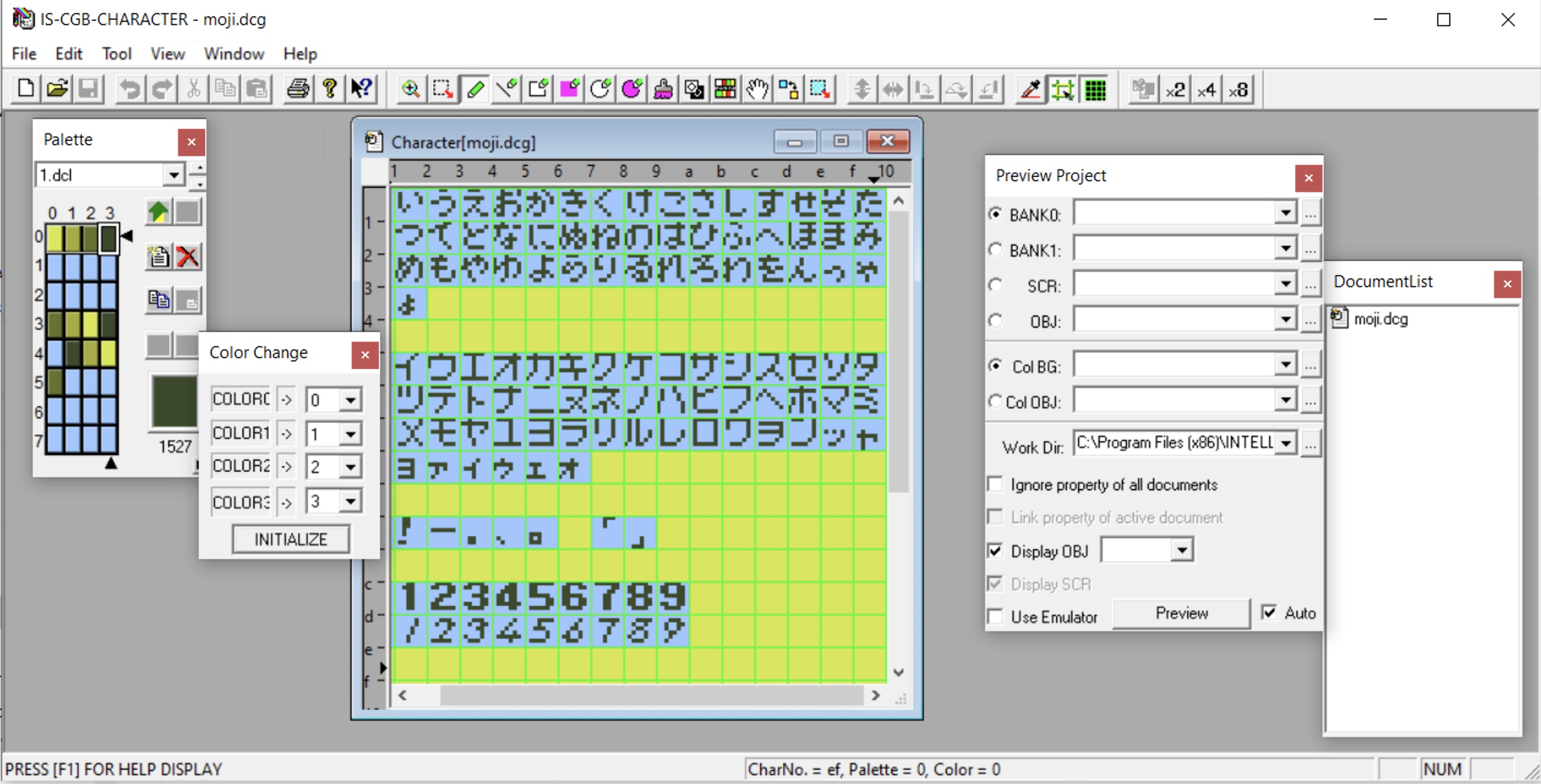 The archive only seems to contains the IS-CGB-CAD tool, which is a CAD (COmputer Aided Design) tool for graphics, sprites and Tiles, which are known as are known as “characters” for the GameBoy.
Its known as a Character development system.
The archive only seems to contains the IS-CGB-CAD tool, which is a CAD (COmputer Aided Design) tool for graphics, sprites and Tiles, which are known as are known as “characters” for the GameBoy.
Its known as a Character development system.
Based on the IS-CGB-CHARACTER-000703jp.exe installer found in the IS-SUPPORT leak material, the CAD tool payload includes the following notable files:
| Path in installer | What it is |
|---|---|
Program Executable Files\\ISCGBCAD.exe |
Main Win32 CAD editor executable |
Program Executable Files\\Iscgbcad.com |
12 KB companion program (purpose unclear without deeper RE) |
Shared DLLs\\ISCGB.DLL |
Main shared DLL shipped with the tool |
Help Files (Japanese)\\FORMAT.TXT |
Japanese format notes (documents DCG, DSC, DOB, DCL) |
Help Files (Japanese)\\help\\*.html |
Japanese HTML help set for the editor UI |
Example Files\\O2T.C |
Small C example shipped with the installer |
The FORMAT.TXT file is especially valuable because it gives concrete byte layouts and bitfields:
DCG- a combined tile + attributes + color bundle (2bpp tile data plus palette metadata)DSC- a screen map with one byte of tile index plus one byte of attributes per cell (the split map model used by CGB)DOB- a chunked object and animation container with tagged blocks like"CGB ","ANIM","GRP ","SIZE","LINK","VER ", and"END "DCL- a small packed RGB555 palette block (2 bytes per color)
The executable payload also reveals how the editor talks to Nintendo’s emulator / hardware layer.
| Editor component | What it does |
|---|---|
ISCGBCAD.exe |
The Windows GUI editor. It loads iscgb.dll at runtime and resolves the CGB* API via GetProcAddress. |
ISCGB.DLL |
A shared DLL that exports the CGB* API used by the editor. |
Iscgbcad.com |
Despite the .com extension, this is a small CGB ROM image with the title IS-CGB-CAD PIC. The Windows editor looks for it and shows an error if it is missing. |
The ISCGB.DLL export table includes these named entry points:
| Export name | Likely role |
|---|---|
CGBOpen |
Open a connection / session |
CGBClose |
Close a connection / session |
CGBRead |
Read from the target |
CGBWrite |
Write to the target |
CGBSetMBC |
Configure MBC state (banking) for transfers |
CGBGo |
Start / run (or resume) execution |
CGBFindFirst / CGBFindNext / CGBFindClose |
Enumeration helpers used by the editor UI |
The editor also looks up two unnamed exports by ordinal (8324 and 16345) in addition to the named ones.
At the strings-and-API level, ISCGB.DLL looks like it can use low-level SCSI-style device paths (for example \\\\.\\SCSI%d:), and it references WNASPI32.DLL, which suggests an ASPI-based transport path for talking to the emulator hardware.
In other words, ISCGB.DLL is not just a random dependency: it is the CAD tool’s device and transfer layer.
The Windows GUI editor resolves these CGB* entry points at runtime and uses them to enumerate available targets, set bank state, and move data to and from the emulator/hardware environment.
When reverse engineering these binaries you will also see a lot of MFC plumbing.
For example, AfxGetModuleState is an internal MFC helper that returns a module state pointer (AFX_MODULE_STATE) used for resource loading and per-module bookkeeping in MFC-based EXEs, DLLs, and ActiveX controls.
Other shipped components in the installer are also worth calling out, because they hint at the UI layer and the Windows 9x-era driver stack the tool expected:
| Component | Where it appears | Notes |
|---|---|---|
| VxD driver | Shared DLLs\\CGBVIEW.VXD |
Windows 9x-style VxD, likely used by the viewer / emulator transport path |
| SYS companion | Shared Sys\\Cgbview.sys |
Small .sys file shipped alongside the VxD |
| OCX UI controls | Program DLLs\\PathBox.ocx, Program DLLs\\SolidPalette.ocx |
ActiveX controls likely used for path picking and palette preview UI |
| Version notes | Help Files (Japanese)\\version.txt |
Shipped version/change notes for the tool |
| Bundled runtime DLLs | Shared DLLs\\Mfc42.dll, Msvcrt.dll, Oleaut32.dll, Olepro32.dll, msvcirt.dll |
Redistributed Microsoft runtime components typical of the era |
Original Game Boy DMG SDK (Contained in Gigaleak archive called Other.7z)
In the first Nintendo Gigaleak the source code for the original Zelda Links Awakening for the DMG Game Boy was included which contained what is believed to be the full Software Development Kit used both in-house at Nintendo and a few partners such as Systems Research and Development (SRD).
The files included in the Original DMG SDK are described in the table below:
| File Name | Extension | Description |
|---|---|---|
| A | .EXE | DMG Relocatable Macro Assembler Version 1.00 |
| ASMB | .EXE | 6502 Assembler Version 1.10 (Famicom tool created in 1987) |
| ASMD | .EXE | DMG Macro Assembler Version 1.01 |
| ASMDMG | .EXE | DMG Macro Assembler Version 1.01 (Identical to ASMD.EXE) |
| CGE2DMG | .EXE | Converts either CGE or DCG Character graphics to source code (.DMG) |
| CGEDCG | .BAT | Batch file for running FCV with the DCG2BYT script |
| DCG2BYT | .CVT | FCV Script to convert DCG Character Graphics files to assembly code (.DMG) |
| DCGDMG | .BAT | Batch file for character file conversion of a .DCG file to a .DMG source file |
| DMGFUNC | .TB0 | Custom binary format possibly used by ISD debugger tool contains the string “SENGOKU” at the start |
| FCV | .EXE | File Convert Program Version 1.03 (Reads in .CVT files) |
| FDT | .EXE | FMS Debugger Version 2.02 (Famicom Tool?) |
| GENBYTE | .CVT | FCV Script to convert a .COM file to a NES/SNES .X65 source file |
| HDT | .EXE | MMC/HVC Debugger Version 03.05 (Famicom/NES Debugger) |
| IS65 | .EXE | 6502,65816 Relocatable Macro Assembler version 1.00 (Why is there a SNES assembler in here?) |
| ISD | .EXE | I.S. Debugger Version 1.00c |
| ISDMG | .EXE | DMG Relocatable Macro Assembler Version 1.00 |
| ISLINK | .EXE | ISASM Linker Version 1.00 |
| L | .EXE | ISASM Linker Version 1.00 (Presumably just copied to have a shorter name) |
| PW | .EXE | P-ROM Support Program Version 1.26 |
| PW2 | .EXE, .TB0 | P-ROM Support Program Version 2.02d6 |
| SCR2DMG | .COM | MS-DOS Command File Executable for converting .scr files to .DMG files for assembling |
| SHL | .COM, .KEY | MS-DOS Command File Executable but not sure what it is for |
| SHVC | .EXE | SHVC Debugger Version 1.00a |
| VRAMTR | .CVT | VRAM Transfer script that converts a .SCR screen file to either a NES or SNES .X65 file |
| VUP | .EXE | Version UP Program Version 2.09 |
Game Boy SDK File Formats
This SDK seems to use a number of different file formats, but it is not clear what exactly is the purpose of each:
- .DMG - Assembly source code for the Dot Matrix Game (Game Boy)
- .CGE - Character Graphics data (For Famicom?)
- .DCG - Character Graphics data (for DMG Game Boy?)
- .CVT - Custom Conversion scripts that can be executed with
FCV - .SCR - Screen file maybe containing location of character tiles in a level?
- .X65 - Either Famicom or Super Famicom source code
- .COM - Unsure if this is a Windows Command File or something else
NES/Famicom SDK Files
One interesting file is that HDT.EXE is included here which is the NES/Famicom Debugger, as far as I know this is the first time a file from the Famicom SDK has ever been leaked. As no other official NES/Famicom SDK had been leaked this is quite remarkable. It was written by Intelligent Systems between 1986-1989 and seems to read in three file formats: CHR (Character/Tile Data), SCR (Screen data? or Source Data?) and CGD (No Idea, maybe Character Graphic Designer?).
SNES/Super Famicom SDK Files
Another interesting file is that IS65.EXE is included here which is the Official Super Nintendo Entertainment System assembler created by Intelligent Systems in 1990. It seems to have been written by the developer Toshio Sengoku.
The file VRAMTR.CVT which is a script in a custom programming language that is parsed by the FCV program. The comments at the beginning of the file indicate that it takes an input file with a “.SCR” extension and outputs a file with a “.X65” extension.
File Convert Program
The File Convert Program (FCV) tool was created in 1987 by Intelligent Systems so it is likely it was also part of the Famicom Software Development Kit.
The commands in the script appear to be performing various operations related to transferring data to VRAM. For example, the “VRAD=$2000” command sets the screen address, and the “DTPT=0” command initializes the data pointer. The script also includes commands for writing screen data and attribute data to VRAM.
Character Graphics conversion
The Bash script DCGDMG.BAT is used to convert a file with the extension “.DCG” (presumably containing character graphics) from the FM-R50 system (a Japanese computer system from the 80s) to a source code file with the extension “.DMG”.
The script assumes that the FM-R50 file is inserted into Drive A of the computer. The script then uses the FCV tool to do the conversion.
This potentially means that developers for Nintendo were using the Fujitsu FM-R50 or a compatible system to develop Game Boy games and possibly NES and SNES games too.
Third Party SDKs
Many third party game developers to create their own set of development libraries and even assemblers, emulators and debuggers to make Game Boy development easier.
AZ40 Game Boy Assembler Kit (Gremlin)
This is a very old Game Boy assembler kit created around 1991 by Gremlin Graphics Software. Included in the kit the assembler, macros, debugger and Amiga to Game Boy sample converter, Game Boy file clipper, set memory application and a restart application 1.
The SDK can be downloaded from Romhacking.net - Utilities - AZ40 GameBoy Assembler Kit.
Executables included
There are a few executables that can be used in DOS for assembling, debugging and a few sound tools.
| Name | Description |
|---|---|
| ATG.EXE | “AMIGA TO GAME BOY SAMPLE CONVERTER (by R.H.C.)” |
| AZ40.EXE | Game Boy Assembler (Game Boy Esprit Turbo Assembler) |
| DZ40.EXE | Game Boy Debugger (Copyright 1991 Gremlin Graphics Software Ltd.) |
| CUTFILE.EXE | GAME BOY FILE CLIPPER (by R.H.C.) |
| RESTART.EXE | Seems to connect to a Game Boy (to restart it?) |
Along with the release on RomHacking.net there was another release of Game Boy source code that included it in a zip file called BarryLeitch.zip. It seems to have the source code for the music for the Amiga game called “The Humans” along with Game Boy specific source code and the SDK.
Unanswered questions
Who or what was R.H.C?
In the Gremlin SDK it mentions that a lot of tools were by R.H.C, but it is unclear who or what this is.
It could be the initials of an employee who wrote the software or it could be a company. They seem to have written both ATG.EXE and CUTFILE.EXE.
R.H.C was possibly Richard Hutchison as that was a college of Barry and worked on a few titles together, but this is unconfirmed? 2.