
Pokemon Mini
Edit on Github | Updated: 25th May 2026Introduction to the Pokemon Mini
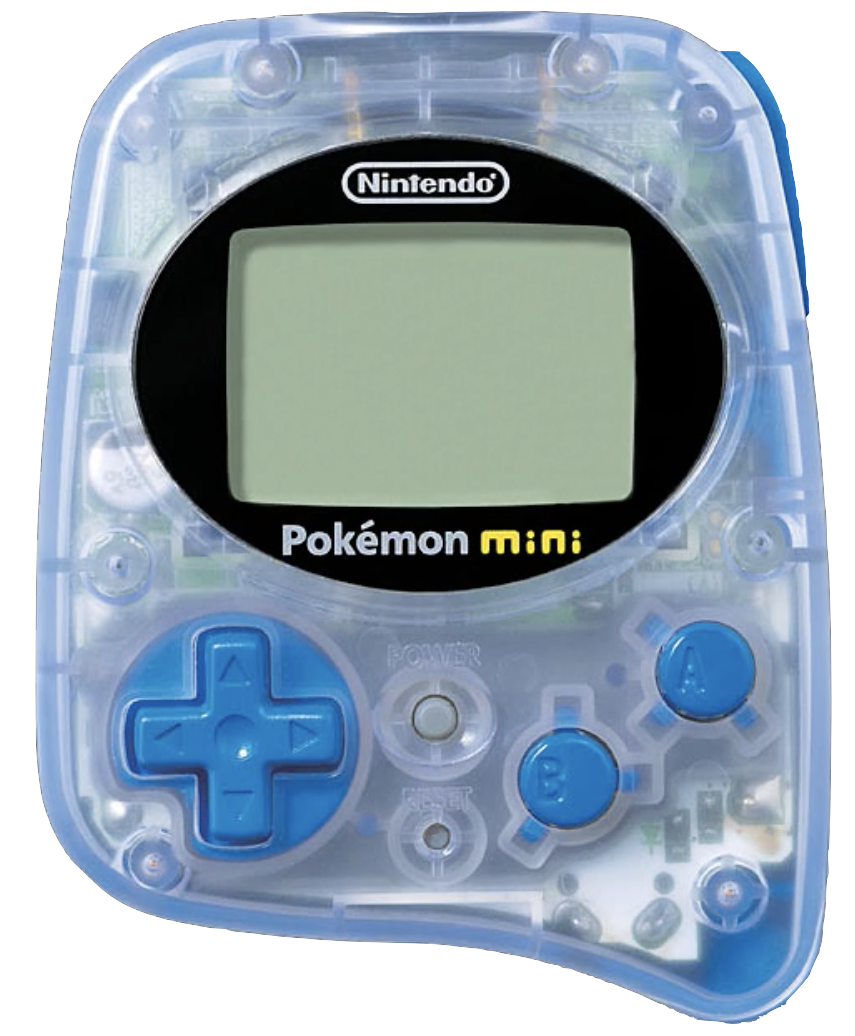 The Pokemon Mini was a low profile handheld games console developed by Nintendo’s System Development Division (SDD) in partnership with
Jupiter Corporation.
It was first unveiled in September 2001 at a Nintendo event called the Nintendo Show, held at Westminster Hall in London, England 1 and released in Japan on December 14th 2001.
The Pokemon Mini was a low profile handheld games console developed by Nintendo’s System Development Division (SDD) in partnership with
Jupiter Corporation.
It was first unveiled in September 2001 at a Nintendo event called the Nintendo Show, held at Westminster Hall in London, England 1 and released in Japan on December 14th 2001.
Nintendo had previously worked with the Jupiter Corporation on hardware such as the Pocket Pikachu which created the foundation for the Pokemon Mini project.
The Japanese company Denyusha was also contracted to create games for the Pokemon Mini and would become one of only 3 developers for the system (SDD, Jupiter and Denyusha).
Despite its innovations and later being emulated on the GameCube, the system struggled to find a market, leading to a small library of games and a dedicated homebrew scene.
Analysis of the Pokemon Mini
The Golden Bolt explores the technical specifications, unique hardware features, and library of the Pokémon mini, Nintendo’s smallest cartridge-based system. This analysis covers the console’s launch history, its place in the market alongside the Game Boy Advance, and the diverse range of games developed for the portable device.
The Capabilities of Pokemon Mini
DidYouKnowGaming has a video where they discuss the unique capabilities such as:
- Internal Real-Time Clock and Timer - Capable of keeping track of time even when the system was powered off.
- Infrared Sensor - Enabled multiplayer functionality, with at least one game supporting up to 10 players simultaneously.
- Built-in Rumble Feature - Provided physical vibration feedback during gameplay.
- Shock Detector - An innovative sensor that allowed players to control on-screen Pokémon by physically shaking the device.
- Battery Efficiency - Boasted a 60-hour battery life powered by a single AAA battery.
Nintendo System Development Division
The Nintendo System Development Division (SDD) was a small development team in charge of lower-profile hardware such as the Pokewalker, Pokemotion and Pokemon Mini 2.
SDD was lead by general manager Masaru Shimomura and in charge of the Pokemon Mini project were the two directors Yoshikazu Mori and Shinya Kawada.
There were two main Pokemon Mini programmers at SDD, Daisuke Tsujimura and Koji Yoshizaki who both worked on titles such as Pokemon Tetris and Snorlax’s Lunchtime, along with also working closely with the Jupiter Corporation and Denyusha to help create games and software for the new handheld 3. At least one of them are thanked in the credits of all games released on the Pokemon Mini! So it is safe to say these two were vital in the development of the Pokemon Mini, at least in terms of the software produced for it.
The games SDD developed for the Pokemon Mini are as follows:
- Pokemon Shock Tetris - Pokemon themed version of Tetris
- Snorlax’s Lunchtime - Only released as part of the Pokemon Channel Gamecube game
Employees at SDD responsible for Pokemon Mini programming:
- Daisuke Tsujimura
- Koji Yoshizaki
Jupiter Corporation
 Jupiter is a very important company when it comes to the Pokemon Mini, in fact they developed more than half of the games available for the console with 6 in total!
Jupiter had a long history working with Nintendo and were trusted licensees of many Nintendo characters after creating game such as Mario Picross in as far back as 1995.
They were responsible for the Pocket Pikachu Color which was released in November 21st 1999 which can be seen as the predecessor to the Pokemon Mini and likely used very similar technology 4.
They also released similar projects for non-Nintendo licensed products such as the Pocket Sakura which is the same hardware as the Pocket Pikachu but could communicate with the Sakura Wars game for gameboy 5!
The games Jupiter developed for the Pokemon Mini are as follows:
- Pokémon Pinball mini
- Pokémon Puzzle Collection
- Pokémon Puzzle Collection vol. 2
- Pokémon Race mini
- Togepi’s Great Adventure
- Pokémon Breeder mini
Employees at Jupiter responsible for Pokemon Mini programming:
- Yoshikazu Mori - Pokémon Pinball mini, Pokémon Race mini, Togepi’s Great Adventure
- Hiroyuki Kawaharabayashi - Pokémon Puzzle Collection, Togepi’s Great Adventure
- Hiraku Kitawaki - Pokémon Puzzle Collection
- Masato Furukawa - Pokémon Race mini
Denyusha
Denyusha were contracted out by The Pokemon Company to make 3 different games for the Pokemon Mini console, according to their official website they started working with the Pokemon Corporation in June 2001 but had already worked with Nintendo since 1998 6.
The games Denyusha developed for the Pokemon Mini are as follows:
- Pichu Bros. mini
- Pokémon Party mini
- Pokémon Zany Cards
Employees at Denyusha responsible for Pokemon Mini programming:
- Go Nagasaka (Pokémon Zany Cards)
- Katsuhisa Okino (Pichu Bros. mini, Pokémon Party mini)
Hardware
Unlike previously thought, Nintendo SDD did not actually create custom hardware for the Pokemon Mini, as it would have been far too expensive for such a low profile device. Instead they used somewhat off the shelf parts as it was recently found out that the CPU is actually a standard Seiko Epson model that was previously used to power similar devices with small LCDs.
The hardware for the Pokemon Mini was provided by Seiko EPSON which included a 8-bit CPU called the S1C88 , it was a cpu that was commonly sold for small portable devices such as watches or pedometers.
Game Development
Official Software Development Kit (Toolchain)
Homebrew SDK
The Pokémon Mini homebrew scene is just starting to take off, with some very talented developers making tools that make it easier than ever to start programming your own games or applications!
Flash Cartridge
It is now possible to flash your games onto a development cartridge thanks to the creation of the Ditto Mini.

Emulation
GBE+ Pokemon Mini Core
Shonumi’s Edge of Emulation article walks through adding Pokemon Mini support to GBE+. It covers the emulator work needed for the memory map, S1C88 CPU, interrupt handling, LCD rendering, input, rumble, shock detector, RTC, infrared, and audio.
Browser-based Emulator
The developer Scylus has created a brand new browser-based (javascript) Pokemon Mini emulator which wile not yet as stable as PokeMini emulator it supports the official S1C88 assembly language. It even contains basic debugging support but there are a few known bugs which cause inaccuracies in the emulation.
Reverse Engineering Pokémon Mini games
Pokémon Mini ROM disassembler - mindis2
ROM Hacking Pokémon Mini games
Tile and Sprite editing
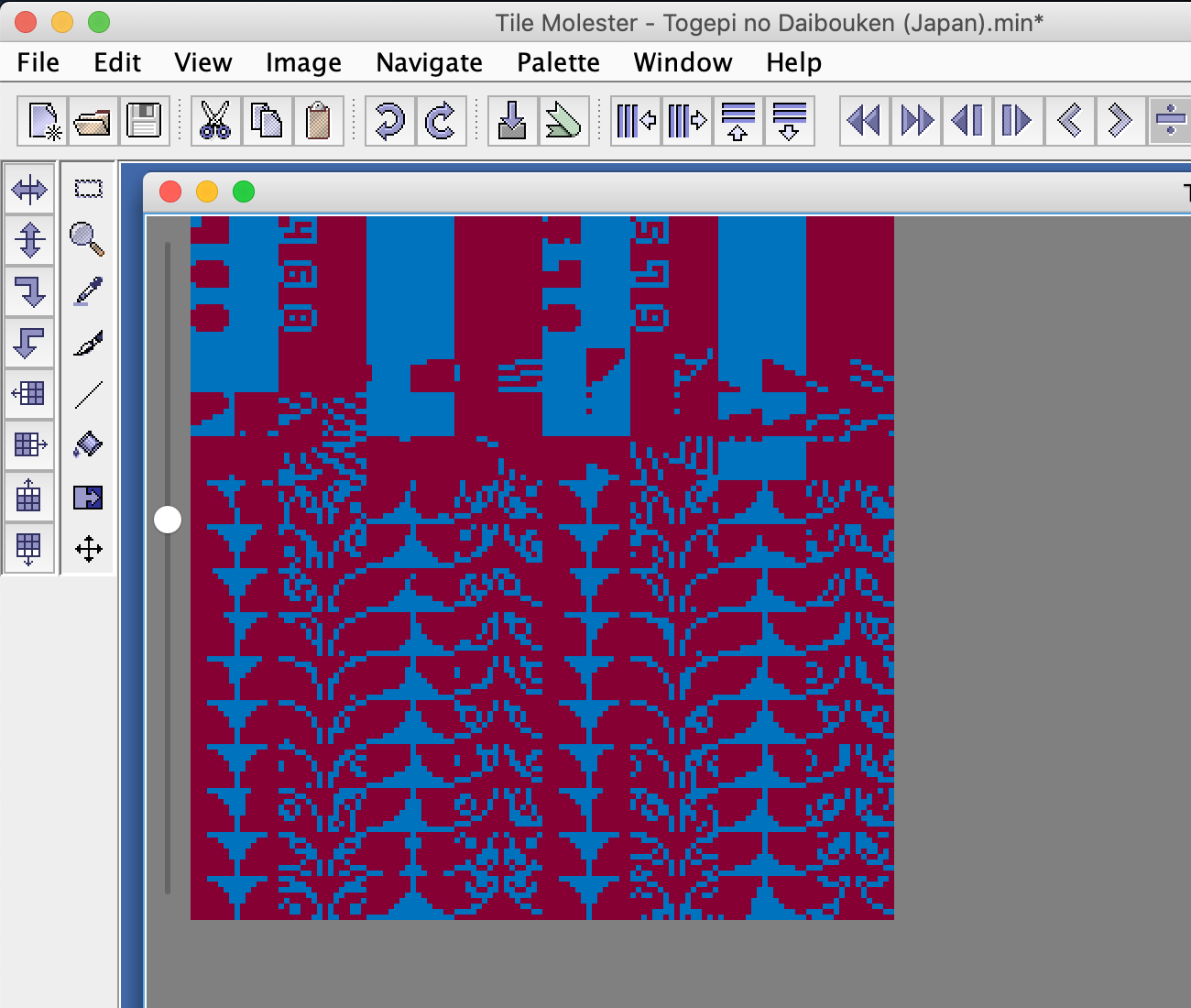 You can open any Pokemon Mini rom file (
*.min) in a tool called Tile Molester with the Codec setup to be 1BPP, as Pokemon Mini is only back and white all images are stored as 1 bit per pixed, with black as 0 and white as 1.
In the screenshot on the left you can see what initially looks like lots of duplicate tiles, these are infact the Masks used for transparency and you can see the tile they apply to to the right of the mask.
ROM Translations
The Pokémon Mini only had a library of 10 games, and 5 of those were only ever released in Japan! Luckily for us a dedicated team of fans have translated the Japanese exclusives into english and are fully playable via flash cart or emulator!


