
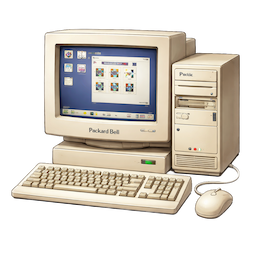
PC-88 - NEC's Influential Japanese Microcomputer
Edit on Github | Updated: 9th August 2026[!error] AI written Not updated yet! Probably very wrong
Development of the PC-88

What programming languages were used to create PC-88 software?
In a 1985 interview, Nihon Falcom’s Masayuki Kato described the PC-8801 as “a machine that demanded direct manipulation of memory and hardware registers”, noting that most of their work on Dragon Slayer and Xanadu was done in Z80 assembly.
Commercial PC-88 titles were predominantly written in Z80 assembly for performance, particularly games relying on fast scrolling, sprite multiplexing, or timing-sensitive sound routines. BASIC (N88-BASIC), included with the system, served as an entry point for hobby development and some productivity software. Later PC-88MA models supported MS-DOS and high-level languages such as C, but commercial game development continued to rely mainly on assembly for deterministic control over the video and FM sound hardware.
What tools were used to create the art for PC-88 games?
Enix artist testing notes from 1987 reference “pixel boards” and “RGB preview rooms” where artists would repeatedly verify that PC-8801 palette constraints matched intended designs.
Pixel art was often created on external workstations or specialized drawing tools before being converted into PC-88 bitplane formats. Early studios used:
- NEC’s internal graphics editors supplied to licensed developers
- Proprietary in-house editors running directly on the PC-88
- X68000 or FM Towns machines for cross-authoring, then exporting assets to PC-88 formats
Due to 8-color display limitations on early models, artists relied heavily on dithering, careful adjacency of palette indices, and structured shading patterns. Later VA models with 640x200 65-color modes broadened stylistic possibilities.
How long did it take to create typical PC-88 games?
In a 1992 retrospective, Hideo Kodama of Micro Cabin stated that the first Xak title was produced by “a team of five over roughly eight months”, with the majority of engineering time spent on scrolling and text rendering systems.
Small teams were common. Development cycles ranged from 3 to 12 months depending on genre and asset complexity. Studios developing adventure and visual novels often worked faster due to static screens, while RPGs or action games required extended tooling and engine creation.
Why was the PC-88 significant in Japanese game development?
According to a 2010 interview with Nihon Falcom founder Masayuki Kato, “the PC-88 was the proving ground for an entire generation of Japanese creators. Its limitations forced invention”.
The PC-88 became a pivotal platform for early Japanese PC game development due to:
- Widespread adoption in schools and businesses
- Accessible N88-BASIC environment for learners
- Availability of FM synthesis (OPN) sound hardware on later models
- Rich market for doujin games
- Strong backing from NEC and a robust distribution channel
Major franchises such as Ys, Dragon Slayer, Sorcerian, Policenauts, and early visual novels established templates that influenced later PC and console ecosystems.
PC-88 Hardware Details
Video hardware and graphics pipeline

The earliest PC-8801 models used a planar graphics system with 640x200 resolution and an 8-color fixed palette derived from RGB combinations. There was no hardware sprite engine; all animation was achieved through software blitting, often optimized with handwritten Z80 routines. Later VA models expanded to a 65-color palette and supported hardware scrolling.
Audio hardware
Composer Yuzo Koshiro recalled that programming the YM2203 for Ys required “writing long sequences of register values by hand” before later upgrading to macro-based sound drivers.
Audio configuration varied by model:
- Early PC-88: simple PSG (AY-3-8910 compatible)
- Later PC-88: Yamaha YM2203 (OPN) FM synthesis
- Doujin scene: custom or modified sound drivers enabling richer FM patches
FM-supported models became essential for studios producing music-heavy RPGs and action titles.
Storage and media
The system supported:
- 5.25-inch floppy disks (common distribution medium)
- Optional cassette interface on early units
- Hard disk options on later MA systems running MS-DOS
Game Development at Falcom
Internal workflow and tools
A 1988 Falcom technical note states: “Each new game begins with a fresh graphics converter and a fresh sound driver”, highlighting their iterative approach to tooling.
Falcom pioneered efficient reuse of subsystems across titles. Their structure around 1987 included:
- Lead Programmer – Masayuki Kato
- Composer – Yuzo Koshiro or Mieko Ishikawa
- Scenario Planner – Yoshio Kiya
- Graphic Designers – rotating teams of 2 to 4 artists
They maintained custom assemblers, map editors, FM music drivers, and debugging tools for rapid iteration.
PC-88 Source Code
Ys I (1987 by Nihon Falcom)
Partial source materials, including disassemblies and fan analyses of sound drivers, are available through community preservation projects. These include:
- Disassembled Z80 instruction traces
- Reconstructed map formats
- FM and PSG driver documentation
Policenauts (Prototype PC-88 build)
Early assets and test scripts from the uncompleted PC-88 version circulate among preservation groups, offering insight into adventure-engine architecture designed for NEC platforms.