
The disc’s system area begins with the Boot System Initial Program, commonly extracted as IP.BIN. Its size is recorded in the system ID and can vary up to 16 sectors, or 32 KiB of user data, under Sega’s disc format specification 1. In this post we will explore what it is, the purpose of it and how it works.
What is it for?
After the Sega Saturn’s internal BIOS code has been executed the CPU will jump to a location in the IP.BIN which will start the setup for game specific settings and meta data such as the game name and version information.
So you can think of it as both Meta Data for the inserted game and also as the starting point for the CPU.
What the boot ROM chose first
Before it hands control to IP.BIN, the boot ROM decides what kind of startup is possible. Sega’s Boot ROM User’s Manual shows the disc check happening while the Saturn logo appears. A recognized game CD starts the game; otherwise the boot ROM runs the Audio CD control panel, called the Multiplayer in this manual 2. The flowchart also gives a game cartridge priority over a game CD, which explains why a cartridge left in the slot can change the observed boot path.
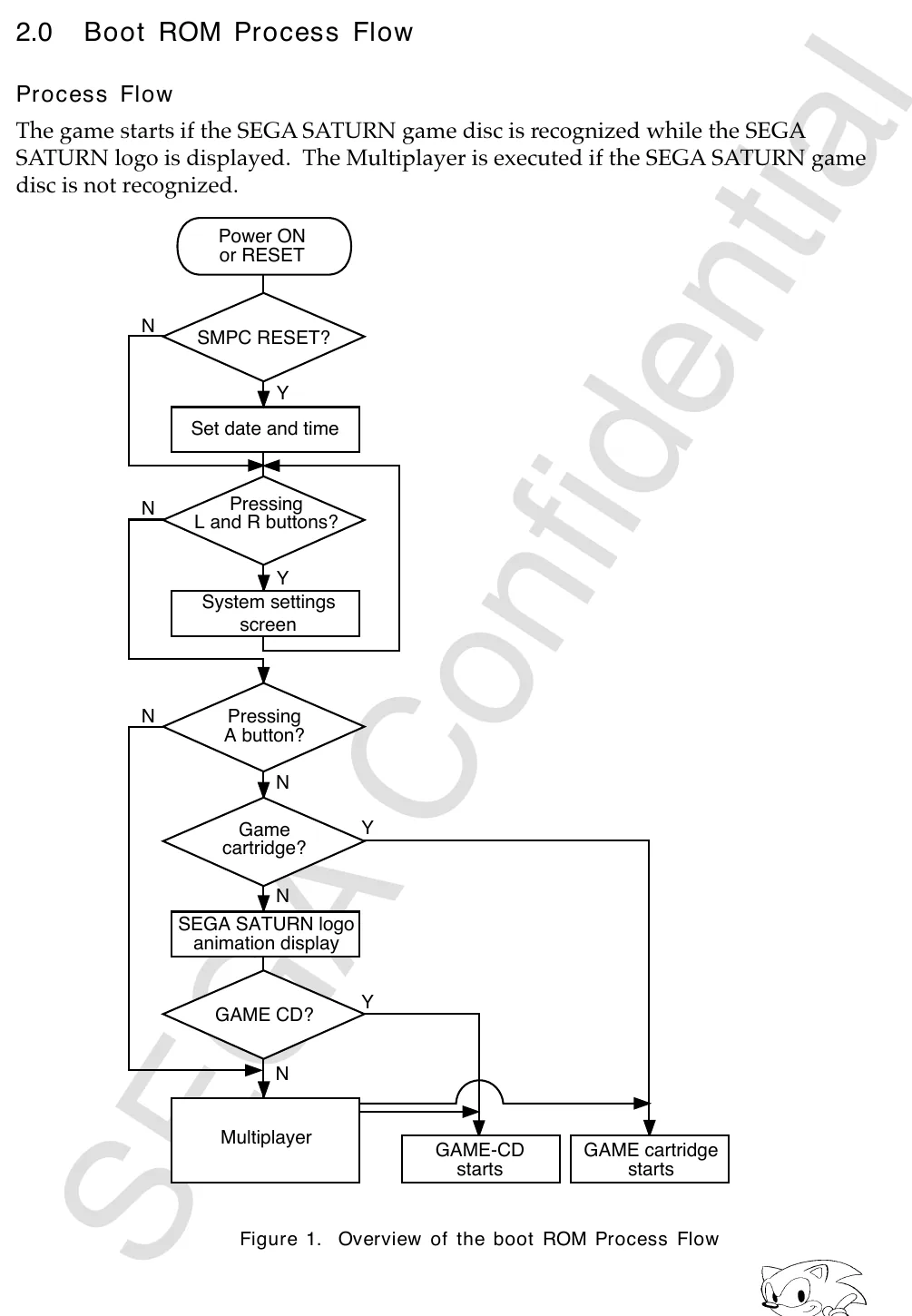
Boot path cropped from the Boot ROM User’s Manual, PDF p. 8. This manual documents a non-Japanese Saturn boot ROM; its paths should not be assumed identical for every region or target box.
The manual distinguishes a production Saturn from a target box, whose boot ROM also checked SCSI devices and SIMM memory for debugging 2. Those development checks belong to the machine’s boot ROM, not to fields inside a retail disc’s IP.BIN.
What does it contain?
Most of the IP.BIN is the same between games with just a few settings changed such as the:
- Maker ID
- Product Number/Version
- Release Date
- Game Name
Content that stays the same between games include:
- Security code (has to be the exact contents of
SYS_SEC.OBJ) - Area code (has to be one of the
SYS_ARE*.OBJfiles )
Sega’s own layout places the system ID first. The title and product fields are near the top, while the IP size and first-read address sit at the end of the 256-byte ID. This makes the diagram useful as a map when looking at a hex dump 1.
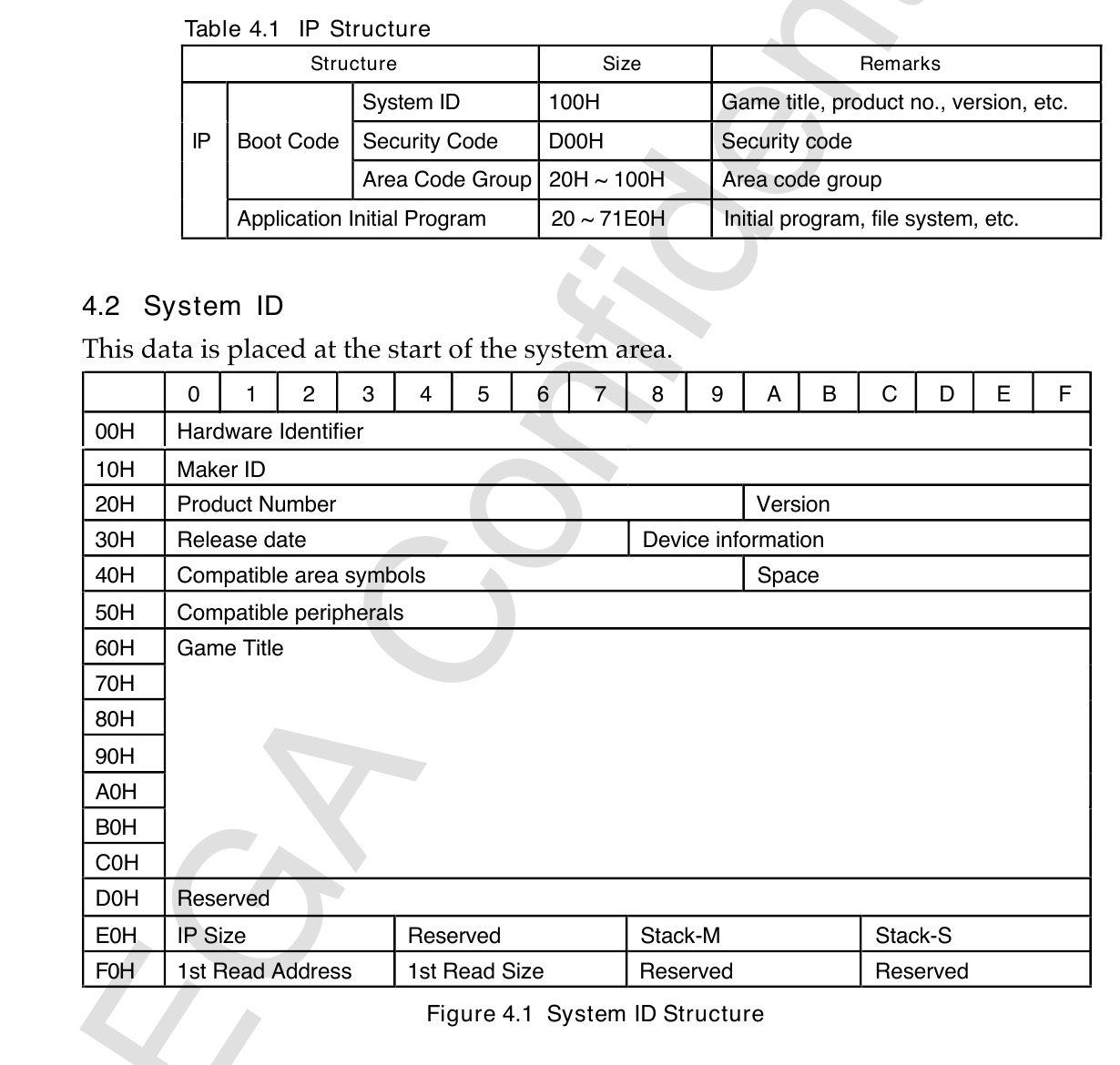
Cropped from Sega’s Disc Format Standards Specification Sheet, PDF p. 29. The narrow-screen version is a reading guide; select the figure for the original field layout.
Official Specification
The specification for the Sega Saturn CD Format including the IP.BIN is defined in the Official SDK documentation as “Disc Format Standards Specification Sheet” 1.
How was it created?
In order to create an IP.BIN for their game developers needed to link together multiple machine code object files along with their own assembly code.
These files included:
- sys_id.obj (game specific meta data assembled from sys_id.src)
- sys_sec.obj (Saturn security code check)
- sys_are*.obj (Region specific code)
- sys_init.obj
- smpsys.obj (Sample Application initial Program compiled from SMPSYS.C)
System ID (Meta Data)
An assembly source file called SYS_ID.SRC is provided by the official SDK for developers to modify and assemble with their own meta data set (such as Game title and version information).
Developers would modify that file and assemble it with the provided assembler to result in a sys_id.obj file. This file is then linked at the start of the IP.BIN executable.
Security Code
The Security code in the IP.BIN file has to be the contents of a compiled object found in the SDK, otherwise the Saturn will not boot the CD. Presumably this is to allow suing unlicensed developers for copyright infringements if it is included on their CDs.
The compiled object file is located in the official SDK at path:
\SATURN\SEGALIB\LIB\SYS_SEC.OBJ
It will be interesting to see if Homebrew Saturn SDKs include this file or not.
Area Codes
In order to region lock games, sega requires developers to include special compiled object files depending on which region they want to target, there are also contained in the\SATURN\SEGALIB\LIB\ directory of the SDK and contains:
- SYS_AREJ.OBJ - Japan
- SYS_ARET.OBJ - Asia NTSC
- SYS_AREU.OBJ - North America NTSC
- SYS_AREE.OBJ - PAL regions such as Europe
You can have multiple area code objects linked, does this mean there are region free Saturn games available?
Linking it all together
There is an example linker file called smpsys.lnk which has the following contents:
Input sys_id.obj
Input ..\segalib\lib\sys_sec.obj
Input  ..\segalib\lib\sys_arej.obj
Input ..\segalib\lib\sys_aret.obj
Input ..\segalib\lib\sys_areu.obj
Input ..\segalib\lib\sys_aree.obj
Input ..\segalib\lib\sys_init.obj
Input ..\smpsys.obj
STart SYSID (06002000)
Output sys_ip.abs
Print sys_ip.map
EXIT
When this linking script is executed it creates a file called sys_ip.abs which can be renamed to IP.BIN.
What the preserved GNU build adds
Sega’s IPGNUSRC package includes SYS_ID.SRC, SMPSYS.C, a makefile, object files, and IPBUILD.TXT, a November 1996 guide to building an IP with GNU tools 3. The guide says to compile an IP for each product rather than patch or reuse one from another disc. Normally the developer could customise the system ID by editing SYS_ID.SRC; the makefile then assembled and linked the parts into IP.BIN.
The package also clarifies what the red and black developer key discs tested. A red disc was for Sega-brand IPs and a black disc for third-party IPs. Within either class, a particular key disc was not paired one-to-one with a particular game. The IP still needed area symbols matching the target Saturn’s region. A third-party code was recorded in the IP for submission review, but the guide says that code itself was not essential to booting 3. This makes the disc’s system ID and area-code objects more useful clues than a supposed unique key-disc match.
Finally, the program’s load and run addresses had to agree with the entry address expected by the IP. The archive’s guide recommends keeping them the same and gives Sega’s default as 0x06010000 3. Sega’s boot-system bulletin explains the timing: the boot ROM loads the first-read file while the licensed Sega logo is displayed, but does not execute that file; the application initial program runs after the area code 4. A bad first-read address could therefore look like a boot failure before the game’s own code visibly starts.
The specification draws those steps as two overlapping tracks: what appears on the TV and what the boot ROM is checking or loading. The licensed-logo interval doubles as useful disc-read time 1.
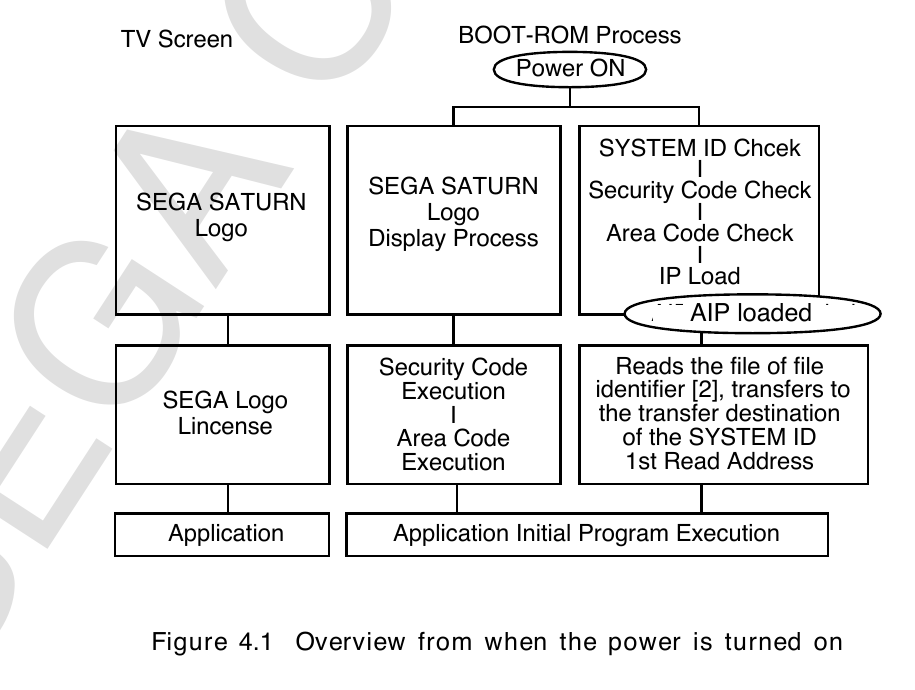
Diagram cropped from the Disc Format Standards Specification Sheet, PDF p. 35. The first-read file is transferred during the licensed-logo screen; the diagram does not show it being executed.
Creating it for Homebrew development
The Homebrew version for the Sega Saturn SDK has its own tool for creation called the IPMaker.
If you are interested in how it works you can check out some of the source code below: IPMaker source Code - SystemID.c
Inspecting IP.BIN in File Lab
File Lab decodes a Saturn Initial Program in the browser. Drop an IP.BIN, or the MODE1/2352 data track, and open the Initial Program tab.
The tab reads the system ID (title, product number, version, date, area symbols, and peripherals), checks the boot ROM limits on IP size and the 1st read address, and lists the SH-2 boot code at the SDK link address 0x06002000. The security code is the fixed SYS_SEC.OBJ block at file offset 0x100. Area objects and the application initial program follow it at 0xE00.
The same fields are highlighted in the Hex tab, using raw sector offsets when the file is a 2352-byte MODE1 track.
References
-
Sega, Boot ROM User’s Manual, PDF pp. 7-10, process flow, cartridge priority, and target-box differences. The manual specifies its non-Japanese ROM scope. ↩ ↩2
-
Sega DTS,
IPGNUSRC.zip, especiallyIPGNUSRC/IPBUILD.TXT,SYS/SYS_ID.SRC, andSYS/MAKEFILE. ↩ ↩2 ↩3 -
Sega DTS, Saturn Technical Bulletins, boot-system explanation in the IP creation bulletin, pp. 43-44 of the PDF. ↩